
Meal planning
How to Meal Plan for a Family of Four on a Budget in Australia
An adaptable seven-day planning framework for an Australian family, without pretending one menu or price suits every household.
Quick answer: Start with a fixed weekly grocery limit, check what is already at home, plan realistic meals that reuse ingredients, turn the recipes into one list, and compare unit prices for the products you will actually use. The illustrative seven-dinner plan below uses repeat ingredients and pantry-friendly meals, but it does not claim a live supermarket total or meet every family's dietary needs.
Australian grocery prices vary by retailer, store, location, promotion and product choice. A useful budget plan therefore needs a method you can repeat with your own postcode and preferred products, not a headline dollar figure detached from its basket.
Before choosing the meals, define the household
“Family of four” is not a standard serving size. Two adults and two young children may need different quantities from four adults or a household with teenagers. Activity, appetite, allergies, culture, medical needs and what is already in the kitchen all matter.
Write down these constraints first:
- The number and ages of people eating each meal.
- Which breakfasts, lunches, dinners and snacks the grocery budget must cover.
- Allergies, dietary requirements and foods the household will not eat.
- Late nights, meals away and how many leftover portions are useful.
- The amount available for food after essential household items are separated.
This guide's example covers seven dinners of four portions each. It is not a complete weekly diet, nutrition prescription or retailer basket.
The Australian Government's Australian Guide to Healthy Eating recommends variety across vegetables and legumes, fruit, grains, lean meats and alternatives, and dairy or alternatives. Requirements vary by age and individual circumstances, so review the rest of the day's food as well as dinner. People who need medical dietary advice should use an appropriately qualified health professional.
A seven-dinner example for four people
This framework uses pasta, rice, tomatoes, onions, carrots, legumes, eggs and frozen vegetables across several meals. Choose recipes your family already accepts, then use their actual ingredient quantities rather than treating these meal names as complete cooking instructions.
Swipe horizontally to compare
| Day | Illustrative dinner | Ingredient overlap | Planning note |
|---|---|---|---|
| Monday | Lentil and vegetable bolognese with pasta | Lentils, tomatoes, onion, carrot, pasta | Cook the number of portions the household will actually eat |
| Tuesday | Chicken and vegetable tray bake | Chicken, potato, carrot, onion, broccoli | Choose the chicken cut and quantity for your recipe and household |
| Wednesday | Vegetable and egg fried rice | Rice, eggs, frozen vegetables | Add safely stored leftover chicken only if Tuesday was deliberately sized for it |
| Thursday | Bean and vegetable chilli with rice | Beans, tomatoes, onion, capsicum, rice | Adjust chilli and seasoning for the people eating it |
| Friday | Tuna, tomato and pea pasta | Tuna, tomatoes, peas, pasta | Check the tuna type and pack size required by the recipe |
| Saturday | Vegetable frittata with toast or salad | Eggs and suitable remaining vegetables | Use leftovers only if they have been stored safely and remain suitable |
| Sunday | Chickpea and spinach curry with rice | Chickpeas, tomatoes, onion, spinach, rice | Confirm coconut milk, spices and accompaniments before shopping |
The plan includes meat, fish, eggs and legumes as different protein sources, but it does not by itself establish that each person has met the Australian Dietary Guidelines. Breakfasts, lunches, snacks, fruit, dairy or alternatives and individual serving requirements still need to be planned.
A starting grocery list to reconcile with your recipes
The quantities below are a planning starting point, not a promise that they will suit every recipe or appetite. Replace them with the quantities from the recipes you select, scale for your household and subtract what you already have.
Swipe horizontally to compare
| Group | Starting items for the seven dinners | What to check before buying |
|---|---|---|
| Grains | About 1kg dried pasta, up to 1kg rice, bread or wraps if wanted | Recipe yields, wholegrain preference, pantry stock |
| Canned foods | 6 cans tomatoes, 2 cans lentils, 2 cans beans, 2 cans chickpeas, 2 cans tuna, 1 can coconut milk | Drained weights, salt or allergen requirements, exact recipe quantities |
| Protein and alternatives | Chicken quantity specified by your tray-bake recipe, 12 eggs | Number eating, intended leftovers, storage and dietary requirements |
| Fresh produce | About 1kg potatoes, 1kg carrots, 6 onions, 1 broccoli, 1 capsicum, spinach and salad produce | Seasonal options, size sold, produce already at home |
| Frozen vegetables | About 500g mixed vegetables and 500g peas | Freezer stock and the mixes required by each recipe |
| Flavour and cooking | Garlic, oil, stock, herbs, spices and curry ingredients | Do not assume a “staple” is already in every household |
Why “about” and “up to”? Produce sizes and recipe methods differ, and package sizes do not always equal recipe quantities. Buying an extra pack merely to make this table exact would undermine the purpose of a budget plan.
How to make the plan fit your budget
1. Use what is already available
Check the fridge, freezer and pantry before finalising meals. A half packet of pasta, frozen vegetables or several cans of beans can change both the plan and the amount that needs buying.
Australian Government healthy eating on a budget guidance recommends planning meals and snacks, making a list, using what is already available, considering seasonal and special items, using leftovers and buying only what is needed.
2. Give every perishable purchase a job
If one recipe uses part of a bunch, bag or tray, identify where the remainder will go. That could be another meal, a lunch or the freezer if the food is suitable for freezing. Do not count a future use unless somebody is likely to follow through.
3. Use flexible, familiar meals
Legume dishes, pasta, rice meals, soups, frittatas and tray bakes can accept different vegetables, but substitutions still need culinary and dietary judgement. The Government's food shopping tips identify dried legumes and grains as cost-effective options and recommend planning meals and shopping to a list.
Familiarity matters too. Food is not good value if the household will not eat it.
4. Compare unit price and usable quantity
The ACCC explains grocery unit pricing as a way to compare similar products using a standard measure such as price per kilogram, litre or item. Use it to compare pack sizes and brands, including promotional products.
The lowest unit price is not automatically the best household decision. Also check:
- The amount paid at checkout.
- Whether the product is genuinely comparable.
- Whether the full pack can be stored and used.
- Whether a special requires buying more than the plan needs.
5. Protect a small flexible amount
Do not allocate every dollar to a precise forecast if the household regularly needs milk, bread, produce replacements or an unexpected extra meal. The appropriate amount is personal; the point is to recognise uncertainty before shopping, not to claim that the plan cannot change.
6. Change the plan before removing essentials
If the priced basket exceeds the limit, revisit meals and product choices systematically. Possible changes include using food already at home, choosing a different recipe with overlapping ingredients, comparing a genuinely equivalent lower-unit-price product or reducing optional extras.
Do not make changes that conflict with allergies, medical needs or adequate food for the household merely to preserve the original menu.
A reproducible Australian basket check
Complete this worksheet on the day you intend to shop. Use one postcode, comparable fulfilment methods and exact products. Record unmatched products rather than pretending they cost nothing.
Swipe horizontally to compare
| Field | What to record |
|---|---|
| Check details | Date, time, postcode, selected store and pick-up, delivery or in-store method |
| Grocery item | Ingredient and quantity needed after checking the kitchen |
| Matched product | Exact product name, brand, variety and pack size |
| Price status | Ordinary price, temporary special, member price or multi-buy condition |
| Unit price | Retailer's displayed price per kilogram, litre, 100g or item |
| Purchase quantity | Number of packs or loose quantity required |
| Line total | Displayed selling price multiplied by quantity purchased |
| Remainder | Amount left after the planned recipes and how it will be used |
| Availability | Available, substituted or unmatched at the selected store |
Add the line totals only after every required item has been handled. Keep retailer fees separate and do not compare a complete basket at one store with an incomplete subtotal at another.
The RecipeRun supermarket comparison guide explains a complete like-for-like method and why the cheapest supermarket can change by basket, date and location.
How RecipeRun supports this workflow
RecipeRun connects the parts that are otherwise easy to maintain as separate notes:
- Save and organise the exact recipes you intend to use.
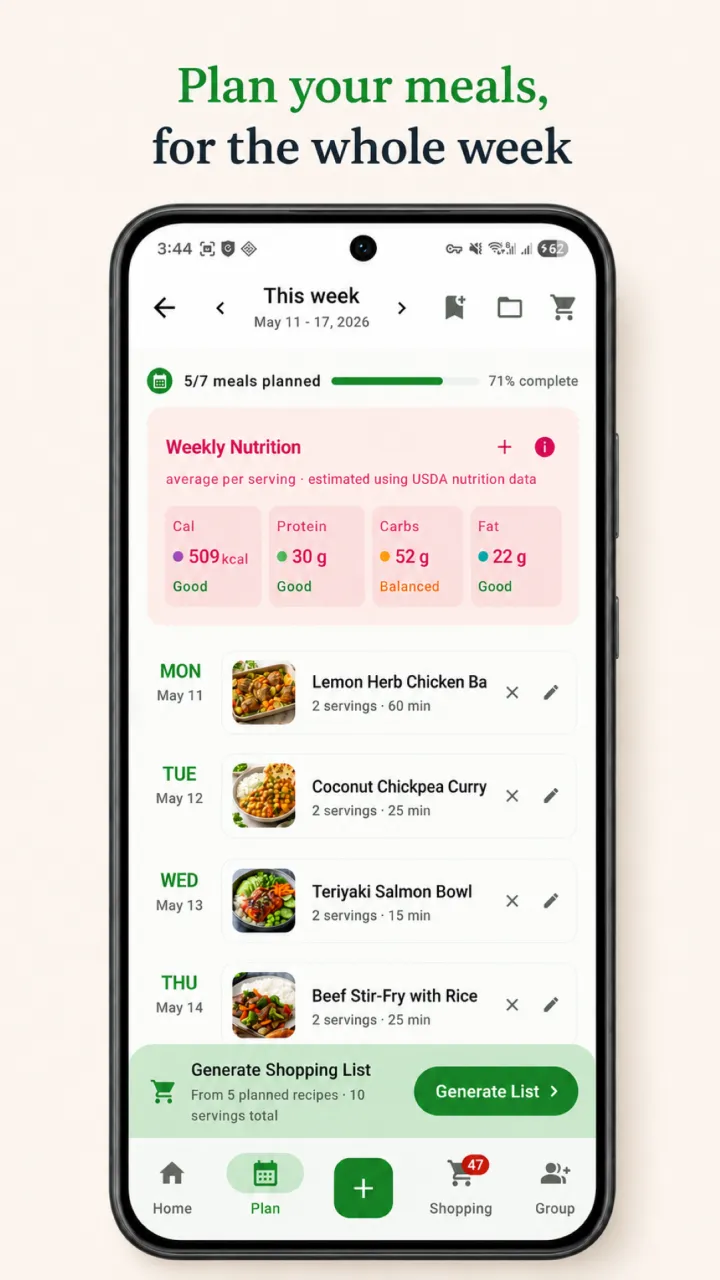
- Put those recipes on a weekly meal plan.
- Generate a grocery list from their ingredients without double-ups.
- Update the list when the plan changes.
- In Australia, compare indicative matched-product prices at selected Woolworths, Coles and ALDI stores.
- Choose preferred products for grocery items so future comparisons increasingly reflect what the household normally buys.
RecipeRun does not know what is in your kitchen, guarantee a complete product match or guarantee the price charged at checkout. Supermarket prices may be cached, incomplete or different by store and method. Review the list, unmatched items, product details and retailer's final price.
See the broader weekly meal-planning and grocery-list system or explore RecipeRun's recipe manager features.
Food-safety note for planned leftovers
If the week relies on leftovers, storage is part of the plan. The NSW Food Authority's leftover guidance advises cooling, covering and refrigerating or freezing leftovers within two hours, storing refrigerated leftovers below 5°C, and reheating them until steaming hot. It gives shorter refrigerated storage guidance for cooked rice and pasta than for many other leftovers.
Follow the food label and the food-safety authority for your state or territory. If in doubt about whether food has been stored safely, do not use it simply because it appears on the meal plan.
Frequently asked questions
What is a realistic grocery budget for a family of four in Australia?
There is no single amount that is realistic for every family. Location, ages, dietary needs, the meals included, retailer access, existing pantry food and product preferences all affect it. Track your own complete basket consistently before choosing a target.
How can I calculate the cost of a weekly meal plan?
Convert each recipe into the quantity you must actually purchase, match exact products, multiply pack prices by the number needed, add unmatched items and fees, and record location and date. Do not price only the portion used while ignoring the full amount paid at checkout.
Is the cheapest unit price always the cheapest option?
No. Unit price helps compare value, but a larger pack can cost more at checkout and may be wasted if you cannot use or store it. Consider both unit price and usable quantity.
Does this seven-dinner plan meet my family's nutritional needs?
It is not designed to make that claim. It covers dinners only and does not account for individual ages, activity, medical needs or the rest of the week's food. Use the Australian Dietary Guidelines and qualified individual advice where needed.
Can RecipeRun guarantee the cheapest supermarket basket?
No. RecipeRun provides indicative prices for selected matched products. Availability, matching, cached data, store location and checkout prices can change. Confirm every product and final price with the retailer.
Plan the next shop from your real recipes
Use meals your family will eat, reconcile the generated list with your kitchen, then price the complete basket using one consistent method. RecipeRun is free to download on Google Play and the App Store.
Sources and disclosure
- Australian Guide to Healthy Eating, Australian Government Eat for Health.
- Healthy eating on a budget, Australian Government Eat for Health.
- Food shopping tips, Australian Government Eat for Health.
- Unit prices for groceries, Australian Competition and Consumer Commission.
- Leftovers, NSW Food Authority.
This guide is published by the team that makes RecipeRun. The sample quantities are illustrative and were not priced as a live retailer basket. RecipeRun is not affiliated with, authorised by or endorsed by Woolworths, Coles or ALDI.