
Meal planning
Meal Planning to Reduce Household Food Waste in Australia
An Australian household workflow that turns food-waste guidance into concrete planning and shopping habits.
Quick answer: Check what needs using before choosing meals, plan fewer meals than your household can realistically cook, write the grocery list from those meals, buy usable quantities, and give leftovers a dated place in the plan. RecipeRun can connect saved recipes, the weekly plan and a combined grocery list, but you still need to inspect your kitchen and decide whether food is safe to use.
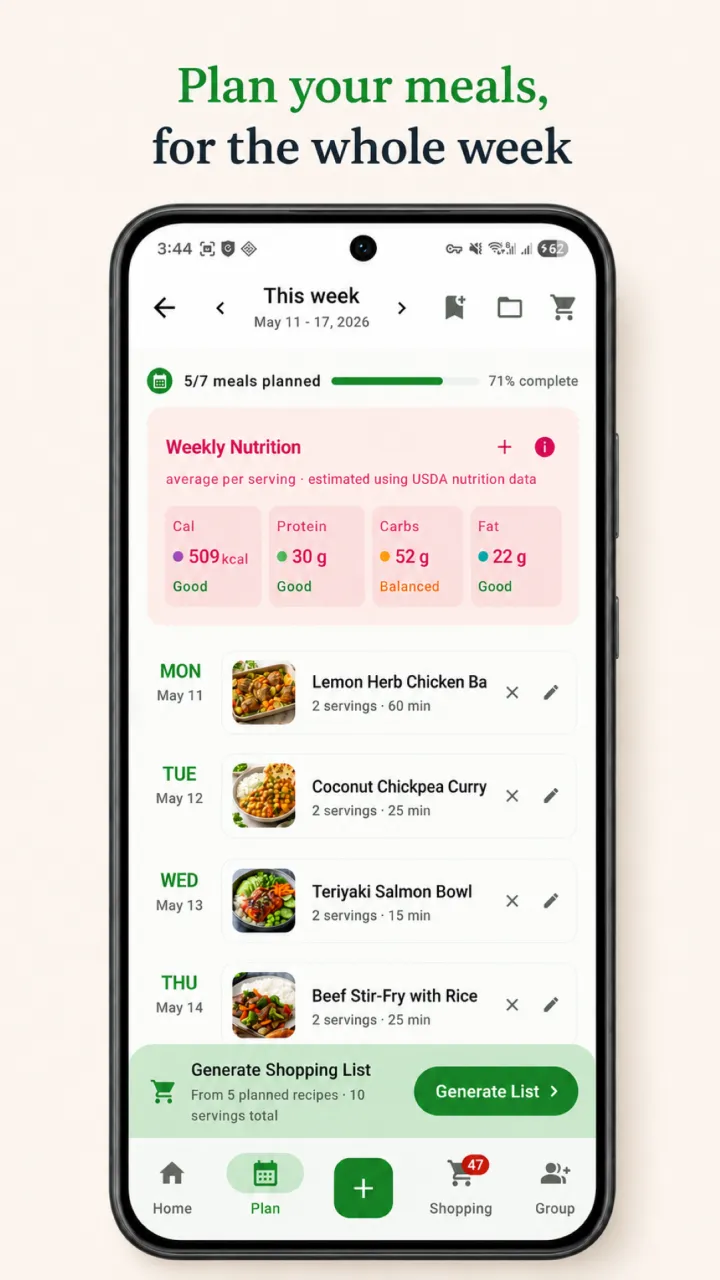
Meal planning will not eliminate every kind of food waste. Plans change, products spoil unexpectedly and some inedible parts remain. Its practical value is making purchased food correspond more closely with meals the household intends to cook.
Why household food waste matters in Australia
The Australian Government Department of Climate Change, Energy, the Environment and Water reports that the 2021 National Food Waste Strategy Feasibility Study estimated about 7.6 million tonnes of food waste across Australia each year. It attributed about 2.5 million tonnes, or 30 per cent of the total, to households.
That national estimate includes more than forgotten vegetables in a fridge, and it does not show what any one family wastes. Start with your own patterns rather than applying a national average to your home.
The NSW Government's Love Food Hate Waste smart-shopping guidance identifies meal planning and writing and following a shopping list as two especially effective household actions. It also recommends checking the fridge and pantry before writing the list and recording the ingredient quantities needed.
A seven-step low-waste meal-planning loop
1. Observe one ordinary week
For seven days, note edible food discarded and the reason. You do not need special scales to see patterns. Useful categories include:
- Bought without a specific use.
- Planned meal was not cooked.
- Pack was larger than the amount used.
- Leftover was forgotten.
- Food was stored incorrectly or too long.
- Household members did not want the meal.
- Product did not meet expectations.
- Food was discarded for a safety reason.
Do not encourage unsafe use merely to improve the record. The purpose is to find the planning decision that can change next time.
2. Check what needs using first
Before selecting recipes, look through the fridge, freezer and pantry. Check labels, condition and storage history. Make a short “use first” list of suitable food that should influence the next few meals.
A meal-planning app cannot determine whether a product has remained at a safe temperature or is still suitable. Follow storage instructions and official food-safety guidance.
3. Plan for reality, including empty spaces
Count the evenings when people will actually eat at home. Add known leftovers, meals out, late finishes and one flexible meal if the week often changes.
Planning five credible dinners can create less excess than buying for seven fixed dinners and abandoning two. A freezer or pantry meal can fill a gap without requiring extra perishable ingredients.
4. Choose meals that share ingredients deliberately
Use the “use first” food in early meals and give the rest of each likely purchase a second destination. Examples include:
- Spinach divided between a curry and a frittata.
- Roast vegetables used as a side, then in a wrap.
- Herbs used in two recipes rather than as one garnish.
- A deliberately larger suitable meal portion reserved for a named lunch.
Ingredient overlap should remain appetising and appropriate. Do not select several unwanted meals merely to use one product; uneaten cooked food is still waste.
5. Build and subtract one grocery list
Generate the ingredients from the chosen recipes, combine genuine duplicates and then subtract what is already available. Add exact quantities where they matter.
Before buying a larger or promotional pack, decide:
- How much the planned meals use.
- How the remainder will be stored.
- Which named meal will use it.
- Whether that second use is realistic before the product deteriorates.
The ACCC's grocery unit-pricing guidance helps compare similar products and pack sizes. A lower unit price can indicate better value, but the full pack still needs to fit the household's use and storage.
6. Make leftovers visible and safe
Label stored leftovers with what they are and when they were prepared, then place them on the meal plan rather than relying on memory. Keep a simple freezer list if frozen portions are hard to see.
The NSW Food Authority's leftover guidance advises cooling and covering leftovers and putting them in a fridge or freezer within two hours. It says to store refrigerated leftovers below 5°C, generally eat them within three days, and eat refrigerated cooked rice and pasta within two days. It also advises reheating leftovers until steaming hot and supplies the two-hour and four-hour rule for food held between 5°C and 60°C.
Follow the label and advice from the food-safety authority in your state or territory. Storage history and the type of food matter; a meal-plan entry is never evidence that a leftover is safe.
7. Review the result before planning again
At the end of the week, ask what remained and why. Change one decision in the next plan:
- Buy a smaller pack.
- Plan fewer meals.
- Reduce the recipe yield.
- Schedule leftovers earlier.
- Stop buying a product the household repeatedly leaves.
- Keep one flexible meal instead of another fresh-ingredient recipe.
Small, repeated corrections produce a plan fitted to the household. A generic “zero-waste” menu cannot know these habits.
An example use-first plan
Suppose the kitchen check finds half a cabbage, several carrots, an open tub of yoghurt and a frozen cooked meal. The goal is not to force them all into one dish; it is to give suitable food a clear destination.
Swipe horizontally to compare
| Food found | Decision before shopping | Possible plan entry | Important check |
|---|---|---|---|
| Half a cabbage | Use early in the week | Stir-fry or slaw matched to a chosen recipe | Condition and storage history |
| Several carrots | Divide across two meals | Tray bake and soup | Quantity actually required |
| Open yoghurt | Use only if suitable | Breakfast, sauce or snack | Label directions, date and storage |
| Frozen cooked meal | Schedule before another batch cook | Busy-night dinner | Label, freeze date and safe reheating |
| Open packet of wraps | Confirm number remaining | Wrap dinner or lunch | Condition and realistic servings |
Once these entries are on the plan, choose recipes and produce the shopping list around them. Do not buy their replacements out of habit.
Understand use-by and best-before dates
Date labels have different meanings. The NSW Food Authority's date-marking guidance says food with a use-by date must be eaten or discarded by that date because it may become unsafe. A best-before date concerns quality; correctly stored food may still be suitable after that date if it is not damaged, deteriorated or perished.
Always follow the product's storage instructions. Do not use appearance or smell to override a use-by date or known unsafe storage.
How RecipeRun can help
RecipeRun addresses the planning and list connection:
- Save recipes from websites, photos, screenshots and handwritten cards.
- Put selected recipes on a weekly meal plan.
- Generate a combined grocery list without double-ups.
- Update the list when the meal plan changes.
- Share recipes, plans and lists through Pro Family Groups.
- In Australia, compare indicative matched-product prices at selected Woolworths, Coles and ALDI stores.
A useful low-waste workflow in RecipeRun is:
- Check the kitchen and identify suitable food to use first.
- Choose or adapt saved recipes around that food.
- Add only the meals likely to be cooked.
- Generate the list and remove everything already available.
- Review quantities and pack sizes before buying.
- Put a planned leftover meal on the week rather than assuming it will be remembered.
- Update the plan when circumstances change so purchased ingredients still have a destination.
RecipeRun does not physically inventory the kitchen, judge whether food is safe, guarantee an ingredient extraction is correct or guarantee a supermarket product match. Users remain responsible for those checks.
Learn how to combine several recipes into one reviewed grocery list, follow the broader weekly meal-planning system, or explore RecipeRun's recipe manager features.
A simple household food-waste review
Use a short table for two or three weeks. Record enough detail to reveal a decision you can change without turning the exercise into a burden.
Swipe horizontally to compare
| Food discarded | Approximate amount | Why it was discarded | Next planning change |
|---|---|---|---|
| Example: salad leaves | Example: part of one bag | Bought for one meal; remainder had no plan | Choose a smaller amount or add a named second use |
| Example: cooked dinner | Example: one portion | Leftover not visible in the fridge | Label it and schedule lunch the next day |
| Example: bread | Example: several slices | Household used less than expected | Freeze a suitable portion earlier |
These are example entries, not measured claims. Use your own observations and follow safe-storage guidance.
Frequently asked questions
Does meal planning reduce food waste?
It can help households buy more closely to intended meals, plan the use of opened packs and make leftovers visible. It cannot prevent every cause of waste, and the result depends on following and updating the plan.
Should I plan every meal for the week?
Not necessarily. Plan only the meals your household can predict usefully. Leaving space for leftovers, a freezer meal or changed plans can avoid excess perishable purchases.
Is food safe after its best-before date?
NSW Food Authority guidance distinguishes best-before from use-by dates. Correctly stored food may remain suitable after a best-before date if it has not deteriorated, but food should not be consumed after its use-by date. Follow the label and relevant authority advice.
How long can I keep leftovers?
It depends on the food and storage history. NSW Food Authority guidance generally says refrigerated leftovers should be eaten within three days, with cooked rice and pasta within two days, and provides separate cooling and reheating rules. Check the full official guidance and local advice.
Does RecipeRun track what is in my fridge?
RecipeRun builds grocery lists from the recipes and meals you choose; it does not physically inspect your fridge, freezer or pantry. Complete that check and edit the list before shopping.
Can supermarket price comparison prevent waste?
Price comparison and waste prevention answer different questions. A low unit price does not help if the extra amount goes unused. Compare value only after deciding how much the plan genuinely needs.
Plan from what you already have
Check the kitchen, choose three realistic meals and generate the list from those recipes. RecipeRun is free to download on Google Play and the App Store.
Sources and disclosure
- Reducing Australia's food waste, Australian Government Department of Climate Change, Energy, the Environment and Water.
- Smart shopping, NSW Government Love Food Hate Waste program.
- Planning your meals, NSW Government Love Food Hate Waste program.
- Unit prices for groceries, Australian Competition and Consumer Commission.
- Leftovers, NSW Food Authority.
- Date marking and storage advice, NSW Food Authority.
This guide is published by the team that makes RecipeRun. It provides general planning information, not medical, dietary or food-safety advice for an individual's circumstances.