
Meal planning
How to Combine Several Recipes Into One Grocery List Without Duplicates
A worked three-recipe method for consolidating ingredients without accidentally merging products that are not equivalent.
Quick answer: Choose the exact recipes and servings, collect all ingredients, merge only ingredients that are genuinely interchangeable, total compatible quantities, remove food already at home, then convert the result into purchase quantities. RecipeRun generates one grocery list from recipes on your meal plan and avoids double-ups, but you should still review ingredient names, units and product requirements before shopping.
The difficult part is not copying ingredients. It is deciding when two lines mean the same thing and when a small wording difference matters.
The reliable six-step method
1. Confirm the recipes and servings
Do not start merging until each meal has an actual recipe and intended yield. “Pasta on Monday” cannot generate a useful list; the chosen pasta recipe can.
Check imported recipes before planning with them. A website may omit a quantity, and text extracted from a photo, screenshot or handwritten card can be misread. Resolve those issues in the recipe instead of carrying uncertainty into the shopping list.
2. Scale each recipe separately
Adjust each recipe for the number of portions you need before combining ingredients. This keeps the calculation traceable: if the weekly total looks wrong, you can return to the individual recipe and check its yield.
Use judgement when scaling. Four servings to eight may double pasta or vegetables, but seasonings, oil, pan size and cooking time do not necessarily scale in the same way. Preserve “to taste” and optional ingredients as instructions to review rather than converting them into false precision.
3. Normalise names without losing meaning
Make obvious naming consistent:
brown onionandbrown onionscan usually be reviewed together.2 cloves garlicandgarlic, 3 clovesdescribe compatible quantities.400 g canned tomatoesand1 x 400 g can tomatoesmay refer to the same purchase amount.
Do not merge simply because words overlap:
- Red onion, brown onion and spring onion can have different roles.
- Fresh spinach and frozen spinach may behave differently in a recipe.
- Plain flour and self-raising flour are not equivalent.
- Gluten-free, low-sodium, halal, kosher or allergen-safe requirements must not disappear during merging.
4. Add only compatible quantities
Quantities can be added when the ingredient identity and units are compatible. Convert units carefully where appropriate, such as grams to kilograms. Do not add “one bunch” to “100 grams” unless you have a reliable weight for the particular product.
Keep recipe quantity separate from purchase quantity. A combined list might require 1.2 kilograms of canned tomatoes, while the purchasing decision is three 400-gram cans. Both facts are useful.
5. Subtract what you already have
Check the fridge, freezer and pantry after the recipe totals are clear. Record whether there is enough, not merely whether the ingredient exists. A nearly empty spice jar and a full jar are not the same answer.
RecipeRun does not automatically know the contents or condition of your kitchen. The household needs to edit the generated list accordingly.
6. Review the shop-ready list
Translate the remaining requirement into the pack size or loose quantity you intend to buy. Check optional ingredients, substitutions, dietary specifications and items with no exact product match.
If comparing Australian supermarket prices, compare the actual matched product and pack size. Indicative prices can be cached, incomplete or different at checkout, so confirm availability and the final retailer price.
Worked example: three recipes, one list
Imagine a week containing beef bolognese, chicken curry and bean chilli. These lines are deliberately incomplete recipe excerpts used to demonstrate merging; they are not full cooking instructions.
Swipe horizontally to compare
| Ingredient | Beef bolognese | Chicken curry | Bean chilli | Reviewed combined requirement |
|---|---|---|---|---|
| Brown onion | 1 | 1 | 2 | 4 brown onions |
| Garlic | 2 cloves | 3 cloves | 1 clove | 6 cloves garlic |
| Canned tomatoes | 400g diced | None | 800g crushed | Keep 400g diced and 800g crushed unless substitution is acceptable |
| Beef mince | 500g | None | None | 500g beef mince |
| Chicken | None | 500g | None | 500g chicken of the cut specified by the recipe |
| Kidney beans | None | None | 2 x 400g cans | 2 cans, with drained weight checked if the recipe specifies it |
| Salt | To taste | To taste | To taste | Check pantry; do not invent a numeric total |
This example shows three different outcomes:
- Direct merge: The same brown onions and garlic can be totalled.
- Conditional merge: Diced and crushed tomatoes share a category, but texture may matter. Keep them separate unless the cook accepts the substitution.
- No merge: Beef, chicken and kidney beans remain distinct even though they can all serve as a recipe's protein component.
How to handle common ingredient conflicts
Different units
Convert only when the relationship is known. 500g and 1kg can be totalled as 1.5kg. 1 cup spinach and 200g spinach should not be merged using a guessed conversion.
Whole items and partial items
A recipe may request half an onion while the shop sells whole onions. Total the recipe requirement first, then round the purchase quantity sensibly. Record how any likely remainder will be used.
Cans, drained weights and pack sizes
400g can chickpeas may refer to net can weight, while a recipe can specify drained chickpea weight. Read the recipe and product label carefully. Two cans with the same external weight can still differ in drained contents.
Optional ingredients
Keep optional items visibly optional. Decide before shopping rather than allowing every garnish and serving suggestion to enter the list automatically.
Pantry staples
Oil, salt, spices and stock are frequently labelled “pantry staples”, but no staple is universal. Check the quantity and use-by or best-before information rather than silently deleting them.
Ingredient groups and headings
A recipe may repeat an ingredient in the sauce and the filling. Total both uses within that recipe before merging it with other recipes, or the weekly list can undercount it.
Similar ingredients with dietary consequences
Never collapse a dietary requirement into a generic product name. If one recipe specifies a product due to an allergy or intolerance, preserve that requirement and verify the product label at the point of purchase.
From a recipe total to a useful grocery item
A strong grocery-list line can carry more than a noun. Depending on the household, it may need:
- Ingredient name and total required amount.
- Required variety or dietary specification.
- Purchase amount or pack count.
- Intended recipe or substitution note.
- Preferred brand and size where that preference matters.
RecipeRun lets Australian users choose a preferred product for a grocery item and remembers that choice for future shops. Over time, price comparisons can therefore reflect the household's usual milk, pasta or other product rather than only a generic match.
That preference is a planning aid, not a guarantee that the item will be available or cheapest. Review the current product and price before buying.
Combining recipes in RecipeRun
Save and review recipes
RecipeRun can save recipes from websites, photos, screenshots and handwritten cards. Check the ingredients and instructions after import, particularly where text was extracted from an image.
Put the recipes on the weekly plan
Choose the day and servings. Include deliberate leftover meals in the plan so you do not generate ingredients for a replacement dinner unnecessarily.
Generate the grocery list
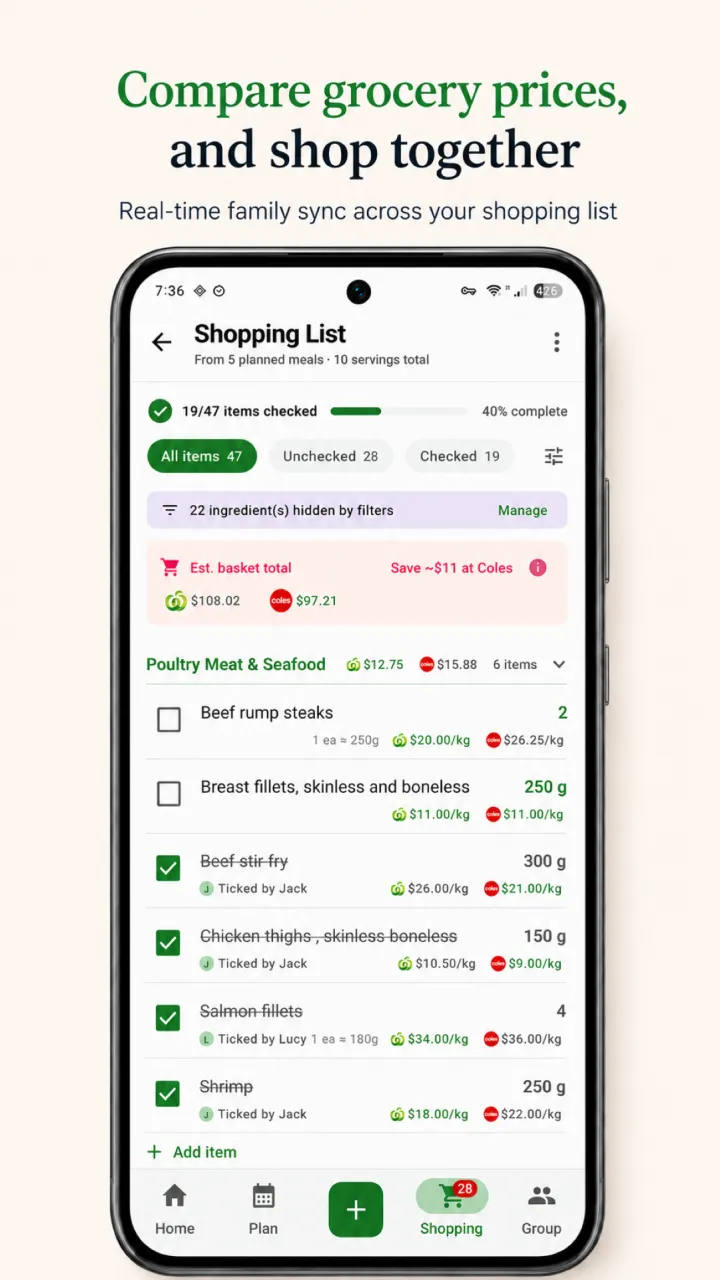
RecipeRun builds a list from the planned recipes without double-ups and updates it when the meal plan changes. Review ambiguous names and quantities, then remove items already in your kitchen.
Add the rest of the shop
Add breakfast, lunch, snack and household items that do not come from the dinner recipes. One complete list is more useful than a precise recipe list plus several forgotten notes.
Share or compare
Pro Family Groups can share the recipes, meal plan and grocery list with household members, including real-time list check-offs. In Australia, selected matched products can be compared across chosen Woolworths, Coles and ALDI stores.
Continue with the full weekly meal-planning guide, the family budget planning example or RecipeRun's recipe manager and grocery-list overview.
Frequently asked questions
How do I combine grocery lists from several recipes?
Scale each recipe first, group genuinely identical ingredients, add compatible quantities, keep meaningful variants separate, subtract pantry stock and convert the remainder into purchase quantities.
Can RecipeRun remove duplicate ingredients automatically?
RecipeRun generates a grocery list from the weekly meal plan without double-ups. You should still review synonyms, variants, incompatible units and dietary requirements because recipe wording can be ambiguous.
Should I merge canned tomatoes with fresh tomatoes?
Only if the recipe permits that substitution and the cook intends to make it. They are not automatically equivalent in quantity, flavour or cooking behaviour.
How do I combine ingredients with different units?
Convert units only when the relationship is reliable. Weight units can usually be converted within the same ingredient; volume, weight, bunches and individual items may need to remain separate.
What if the supermarket pack is larger than the recipe total?
Record the full checkout quantity and price, then plan a realistic use or safe storage method for the remainder. Do not describe only the recipe portion as the amount paid.
Build one list from the meals you chose
Save the recipes, set the servings and review the combined result before shopping. RecipeRun is free to download on Google Play and the App Store.
Disclosure
This guide is published by the team that makes RecipeRun. Ingredient merging and automatic extraction can require correction; the cook remains responsible for recipe accuracy, substitutions, dietary suitability and final product selection.