
Meal planning
Weekly Meal Planning With One Grocery List: A Step-by-Step System
A repeatable weekly routine that connects recipe choices, household schedules and one practical shopping list.
Quick answer: To create a weekly meal plan with one grocery list, check the week and your kitchen first, choose the exact recipes and servings, generate a combined ingredient list, remove food you already have, and revise the list whenever the plan changes. RecipeRun connects saved recipes, a weekly meal plan and an automatic grocery list so you do not need to copy every ingredient by hand.
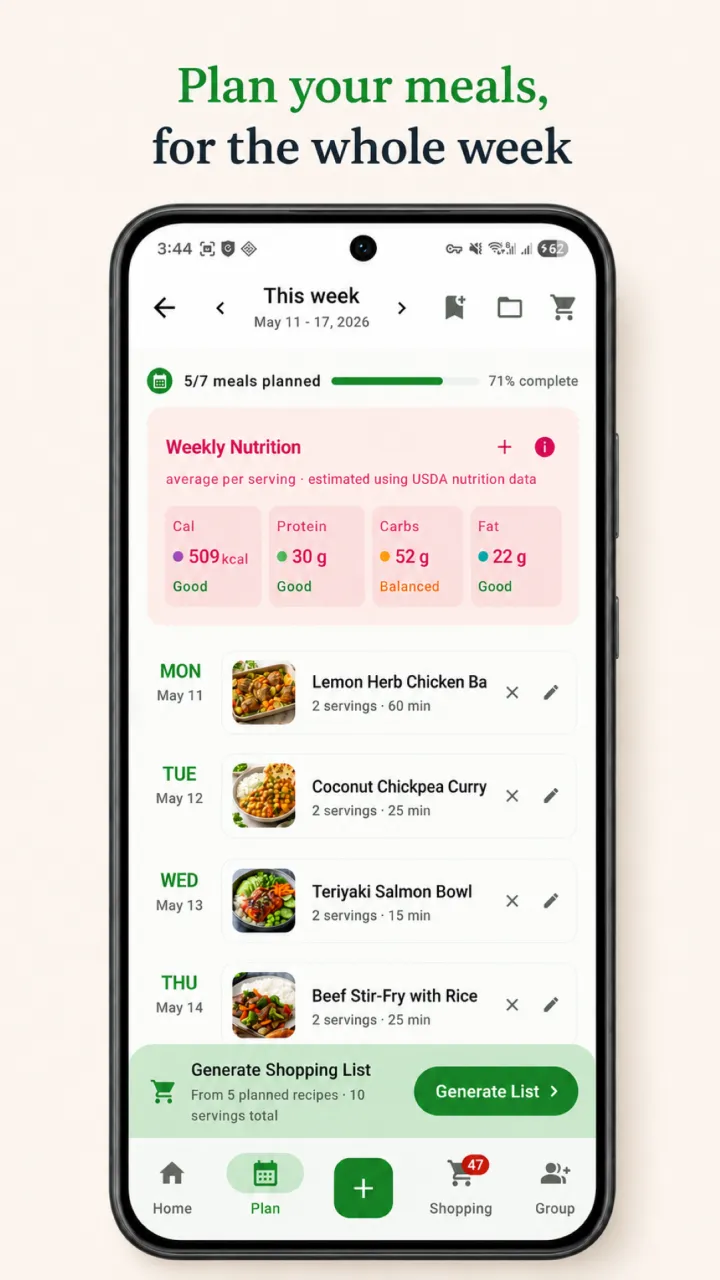
The goal is not to predict a perfect week. It is to make the next grocery shop support the meals you are realistically likely to cook.
The seven-step weekly planning system
1. Plan around the week you actually have
Look at work, study, school, sport, appointments and social plans. Mark the nights that need something fast, the nights when fewer people will be home and the nights when there is time to cook.
A useful plan can include deliberate gaps:
- A leftovers night for food already cooked.
- A flexible night for changed plans.
- A freezer or pantry meal for a late finish.
- A night when no home-cooked meal is planned.
Leaving space is more honest than buying ingredients for seven ambitious dinners and cooking four.
2. Shop your fridge, freezer and pantry first
Before opening the recipe collection, note food that should influence the week. Look for produce that needs using, open packets, frozen portions and staples already on hand.
RecipeRun creates a list from the meals you select, but it does not inspect your kitchen. This physical check is what prevents a useful generated list from becoming an unnecessary shopping list.
3. Choose exact recipes and serving counts
Pick the specific recipe for each planned meal. Confirm how many people will eat it and whether you intend to create leftovers. If the recipe has been imported from a website, screenshot, photo or handwritten card, review the saved ingredients and instructions first.
Serving counts matter because a recipe written for two is not automatically a family dinner, while a recipe written for eight may deliberately cover tomorrow's lunch. Adjust quantities with judgement: not every ingredient scales neatly, particularly seasonings, cooking oils and ingredients sold as whole units.
4. Use ingredients across more than one meal
Look for sensible overlap without making every dinner taste the same. A bunch of spinach could appear in a curry and a frittata; roast chicken could become a later wrap; an open tin or packet could shape the next lunch.
Ingredient reuse is most useful when it follows the pack you will actually buy. If one recipe needs half a cabbage, plan how the remainder will be used or choose a different vegetable. Do not buy a bulk pack solely because its unit price is lower if the extra food is likely to go unused.
5. Generate one combined grocery list
Add the recipes to the week and generate their ingredients as one list. RecipeRun is designed to avoid double-ups and to update the grocery list when the plan changes.
An automatic list is a starting point, not an instruction to buy every line. Review it for:
- Different names for the same ingredient.
- Ingredients that should remain separate, such as red onion and spring onion.
- Quantities written in incompatible units.
- Pantry staples, garnishes or optional ingredients.
- Products that must meet an allergy or dietary requirement.
The detailed guide to combining several recipes into one grocery list shows how to handle these cases.
6. Turn ingredients into a shop-ready list
Subtract what is already at home, then translate recipe quantities into sensible purchase quantities. A recipe may require 600 grams of an ingredient that the shop sells in 500-gram packs. Decide whether to buy more, adjust the recipe or choose a loose product.
For Australian users, RecipeRun can show indicative prices for selected matched products at chosen Woolworths, Coles and ALDI stores. Review the product, size and availability rather than assuming the first match is equivalent. Prices can be cached or incomplete and can differ at checkout; confirm the final price with the retailer.
The Woolworths, Coles and ALDI comparison guide explains pack-size, unit-price and location checks.
7. Keep the plan and list together when life changes
If Thursday's meal moves to Saturday, update the plan before adding a replacement meal. Check whether any purchased perishable ingredients now need to be used earlier. If a recipe is removed, review the grocery list instead of assuming every related ingredient disappeared or can be returned.
For shared households, RecipeRun Pro Family Groups let members share recipes, the weekly plan and the grocery list. List check-offs sync in real time, which helps when more than one person shops. Read the shared family planning guide for a simple household hand-off. For the product workflow, see RecipeRun's family meal planner and shared family grocery list.
An illustrative seven-day plan
This example shows how meals can fit different kinds of evenings. It is not a nutrition plan and does not account for individual allergies, dietary needs, ages or appetites.
Swipe horizontally to compare
| Day | Time available | Meal role | Example approach |
|---|---|---|---|
| Monday | Moderate | Cooked meal | Pasta with vegetables and a chosen protein |
| Tuesday | Short | Fast meal | Stir-fry using vegetables also needed later |
| Wednesday | Moderate | Cook once | Curry or casserole with extra portions |
| Thursday | Very short | Planned leftovers | Reheat Wednesday's stored portion safely |
| Friday | Uncertain | Flexible meal | Wraps, eggs or a pantry-based meal |
| Saturday | More time | New recipe | Try a saved recipe that needs preparation |
| Sunday | Moderate | Use-up meal | Soup, frittata or tray bake shaped by remaining food |
The table is intentionally flexible. The exact recipes should come from what your household likes, what is already available and what the week permits.
A grocery-list review that takes five minutes
Before shopping, read the final list once from top to bottom and ask:
- Need: Is this required for a planned meal or household use?
- Already have: Is enough available, and is it still usable?
- Quantity: Does the total match the planned servings and leftovers?
- Identity: Is this the correct variety, brand requirement or dietary specification?
- Pack: What will happen to any amount left after the recipe?
- Timing: Will the perishable item be used while it is suitable?
This short review catches problems that no recipe importer can reliably infer from the contents of your kitchen or your household's preferences.
How to start in RecipeRun
Save the recipes you already cook
Build a small working collection first. RecipeRun can save recipes from websites, photos, screenshots and handwritten cards. It is more useful to have ten reviewed favourites than a large library you have never checked.
Place meals on the weekly plan
Choose the recipe, day and intended servings. Include meals that deliberately use leftovers or food already at home, even when they add little or nothing to the shopping list.
Generate and edit the grocery list
Create the combined list, resolve any ambiguous ingredients and remove pantry items. Add non-recipe groceries to the same list so you shop from one place.
Review matched supermarket products in Australia
If using price comparison, select local stores by postcode and check the actual matched products. RecipeRun can remember the preferred product you choose for a grocery item, allowing future comparisons to better reflect what your household normally buys.
You can see the complete feature set on the RecipeRun recipe manager page.
Common planning mistakes
Planning seven demanding meals
Match difficulty to the week. Repeating a reliable meal is often more practical than choosing seven new recipes.
Treating the generated list as final
The app does not know what is already in your cupboard, whether a product is safe for a particular allergy or whether you changed a recipe in your head. Review remains essential.
Ignoring recipe yield
Check the original servings and decide whether leftovers are intentional. If you change servings, review the quantities rather than assuming every line scales perfectly.
Comparing supermarket subtotals with unmatched items
An apparently low subtotal may simply exclude products that were not matched. Review unmatched ingredients and compare like with like before deciding where to shop.
Forgetting the plan after the shop
Keep the plan visible and update it when circumstances change. Purchased food still needs a destination even if the original dinner moves.
Frequently asked questions
How many meals should I plan each week?
Plan only as far as your household can use reliably. Three or four dinners plus leftovers and a flexible night may work better than seven fixed meals.
Can an app make a grocery list from several recipes?
Yes. RecipeRun generates a combined grocery list from recipes on the weekly meal plan and avoids double-ups. Review names, quantities, pantry items and dietary requirements before shopping.
Should I plan before checking supermarket specials?
Start with your household's needs and existing food. Specials can influence substitutions, but building the entire plan around promotions can lead to buying products you would not otherwise use.
What if my meal plan changes after I shop?
Move the meal, use its perishable ingredients in another dish, or store them safely where appropriate. Update both the plan and list so the household sees the current version.
Does RecipeRun work outside Australia?
Recipe organisation, meal planning and grocery lists work worldwide. Woolworths, Coles and ALDI price comparison is currently available in Australia.
Build next week's list
Start with three meals, review the recipes and let the list grow from the plan. RecipeRun is free to download on Google Play and the App Store.
Disclosure
This guide is published by the team that makes RecipeRun. RecipeRun supports planning and list organisation; households remain responsible for recipe accuracy, dietary suitability, food safety and final purchasing decisions.