
Australian grocery guide · 2026
How to compare Woolworths, Coles & ALDI prices
Price the list you are actually buying at your own local stores, see what each store is missing, then decide where to shop. Five minutes, and it is your basket, not a survey basket.
See how it worksA real grocery list, four checks, no spreadsheet.
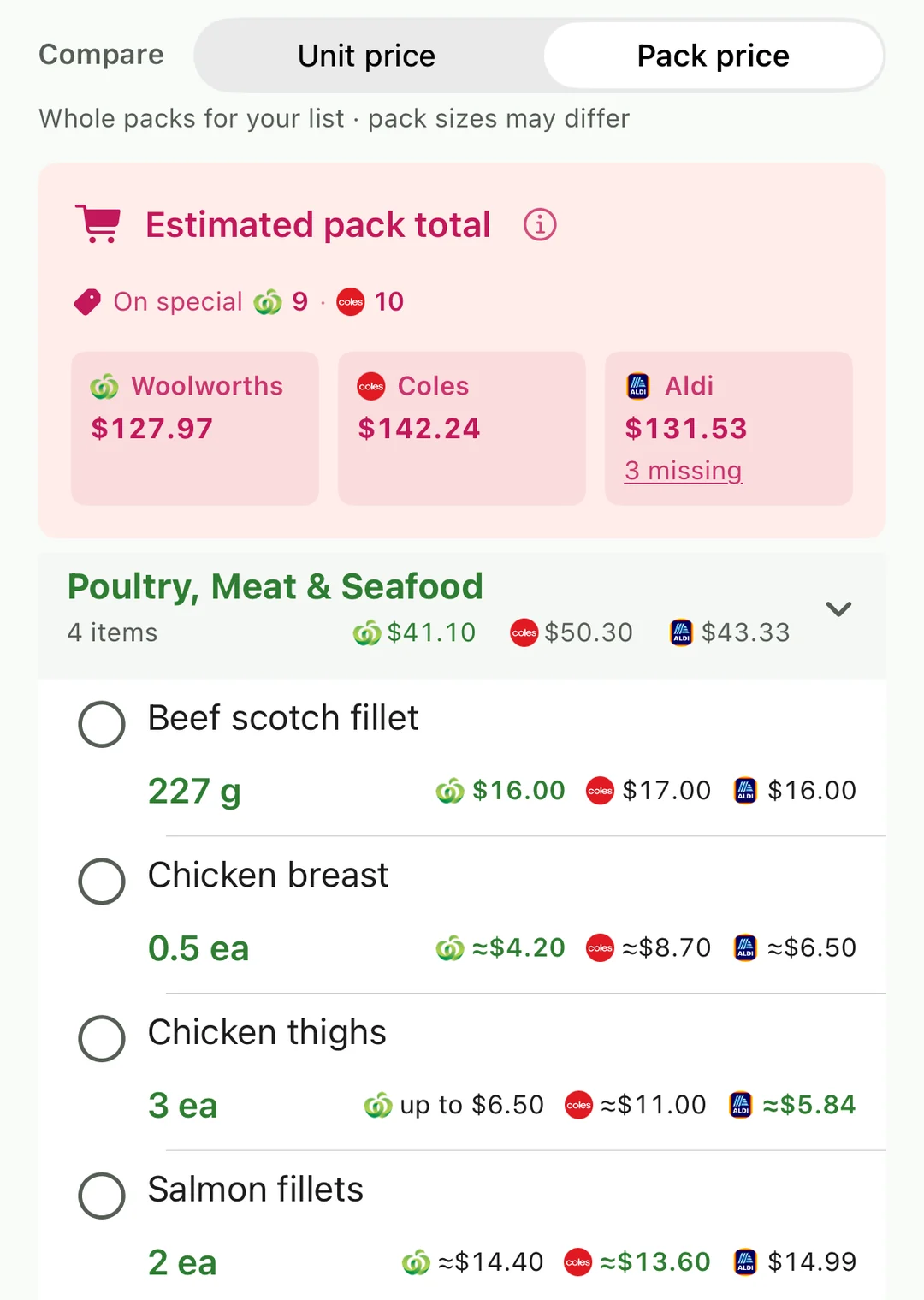
Follow along in the app
Four checks before you shop
Open your shopping list in RecipeRun and work through these in order. The screens were captured on 30 September 2026 from one real list; the prices are that day’s estimates, not today’s shelf prices.
Choose the stores you actually use
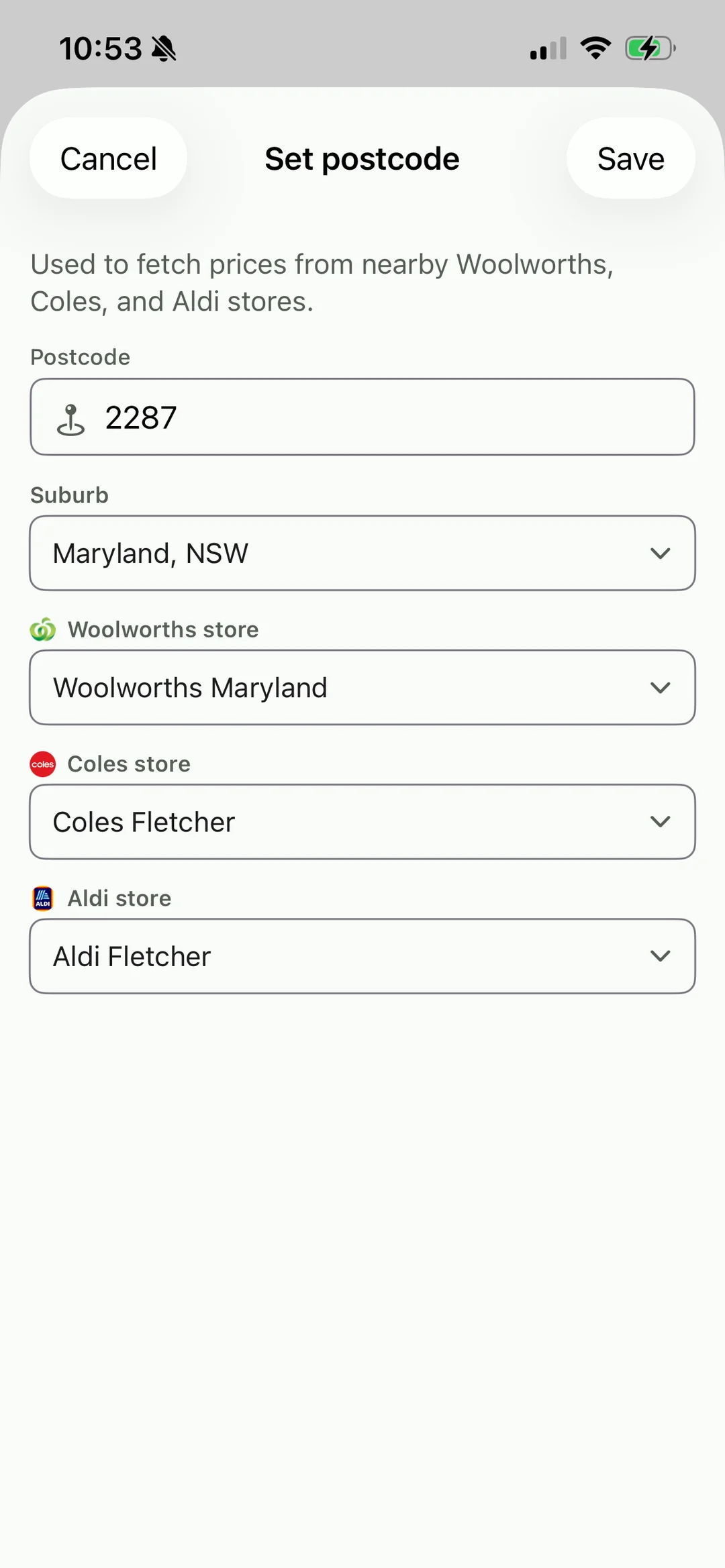
Open the postcode control on your shopping list, enter your postcode and check which branch the app has picked for each supermarket.
Our example uses Maryland NSW 2287: Woolworths Maryland, Coles Fletcher and ALDI Fletcher. Pick the stores you would really drive to, because a comparison against a shop you never visit is just trivia.
Start local. The comparison is only useful if it reflects where you shop.
Read the totals with the missing items
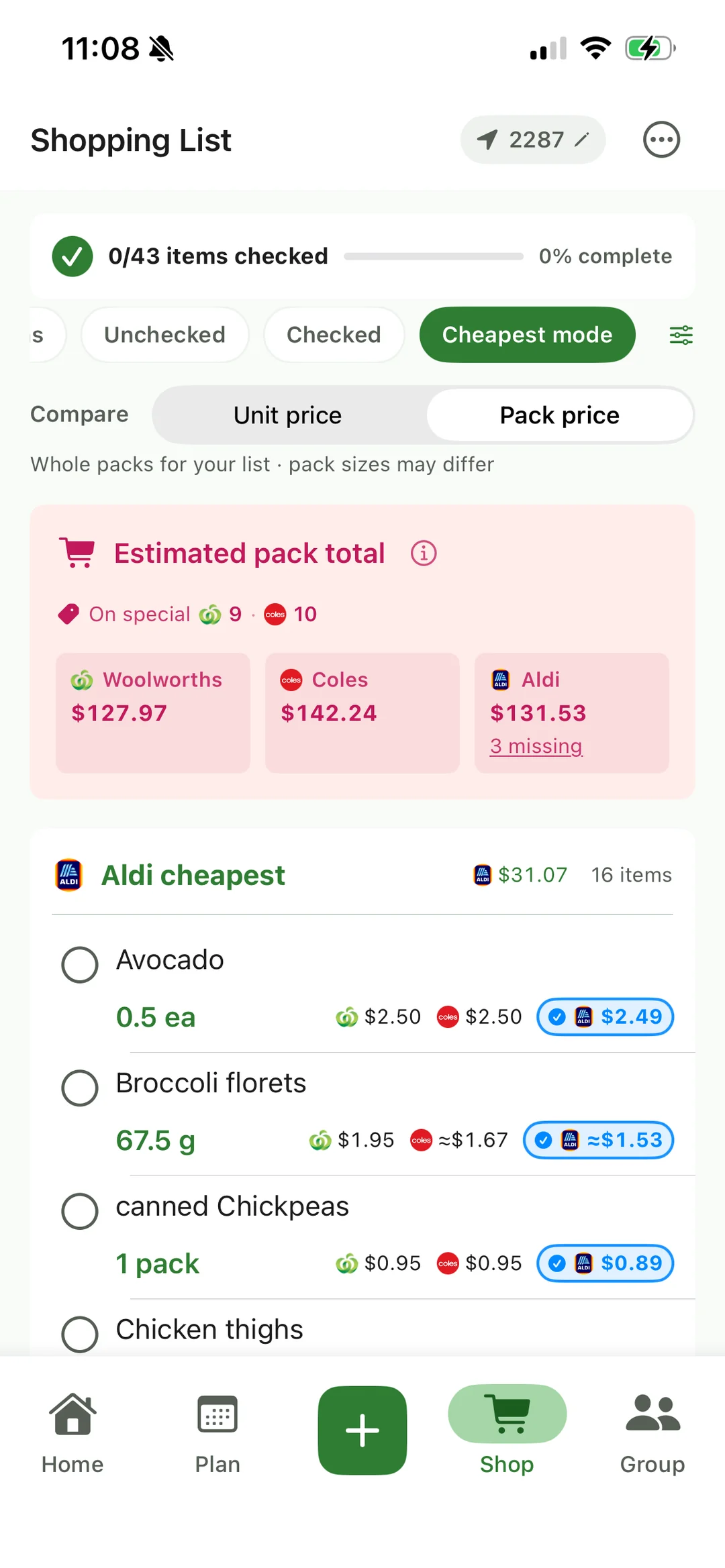
Each store shows an estimated pack total: what the whole packs on your list would cost there. Under each total, a link shows how many items that store could not price. Read the two together.
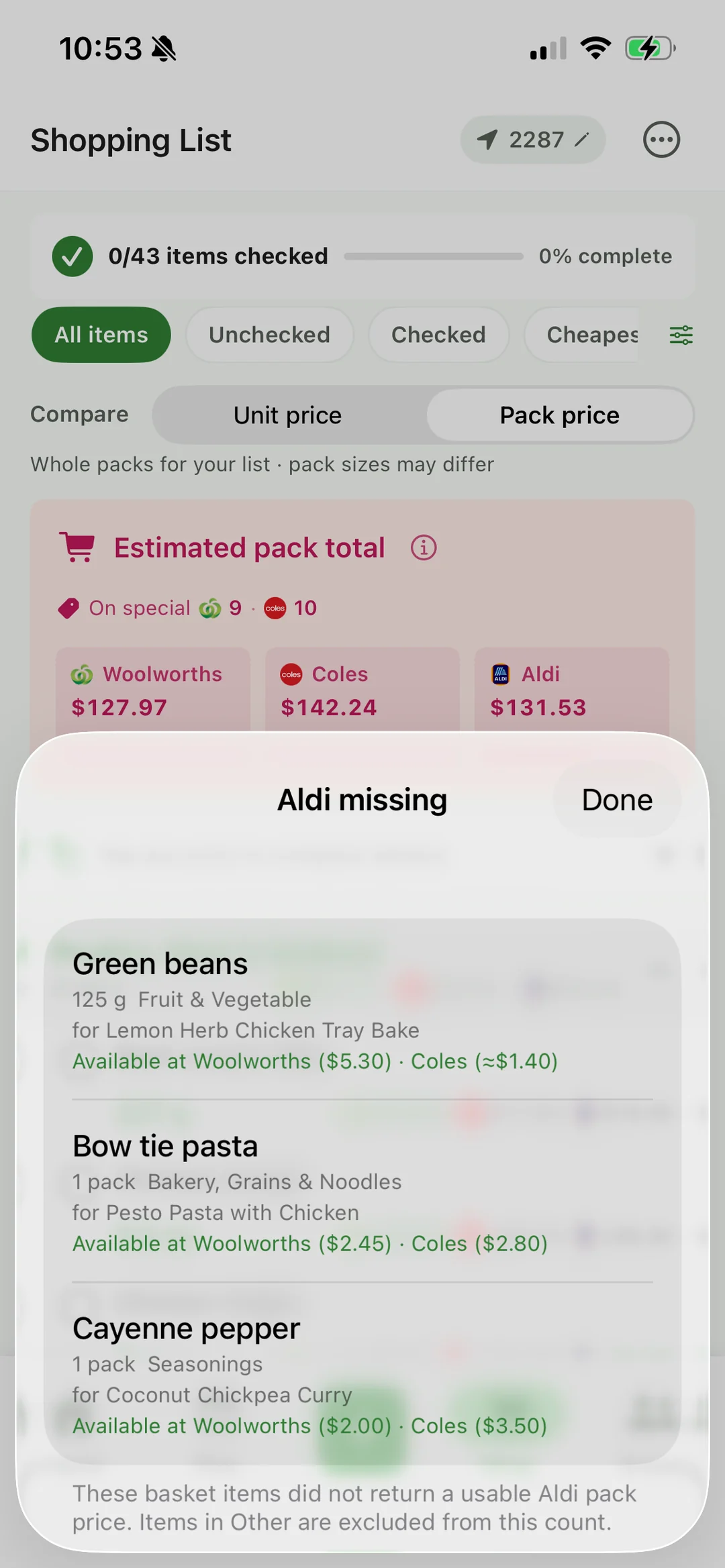
In this 43-item example, Woolworths comes to $127.97 and Coles to $142.24, with every item priced at both. ALDI shows $131.53 but is missing three items: green beans, bow tie pasta and cayenne pepper. Buy those at the cheaper of the other two stores, about $6 more, and ALDI lands near $137. On that day’s pack-price estimates, Woolworths came out lowest for the whole list.
Tap a missing count to see which items you would need to buy somewhere else, and what they cost there.
Check what is behind each price
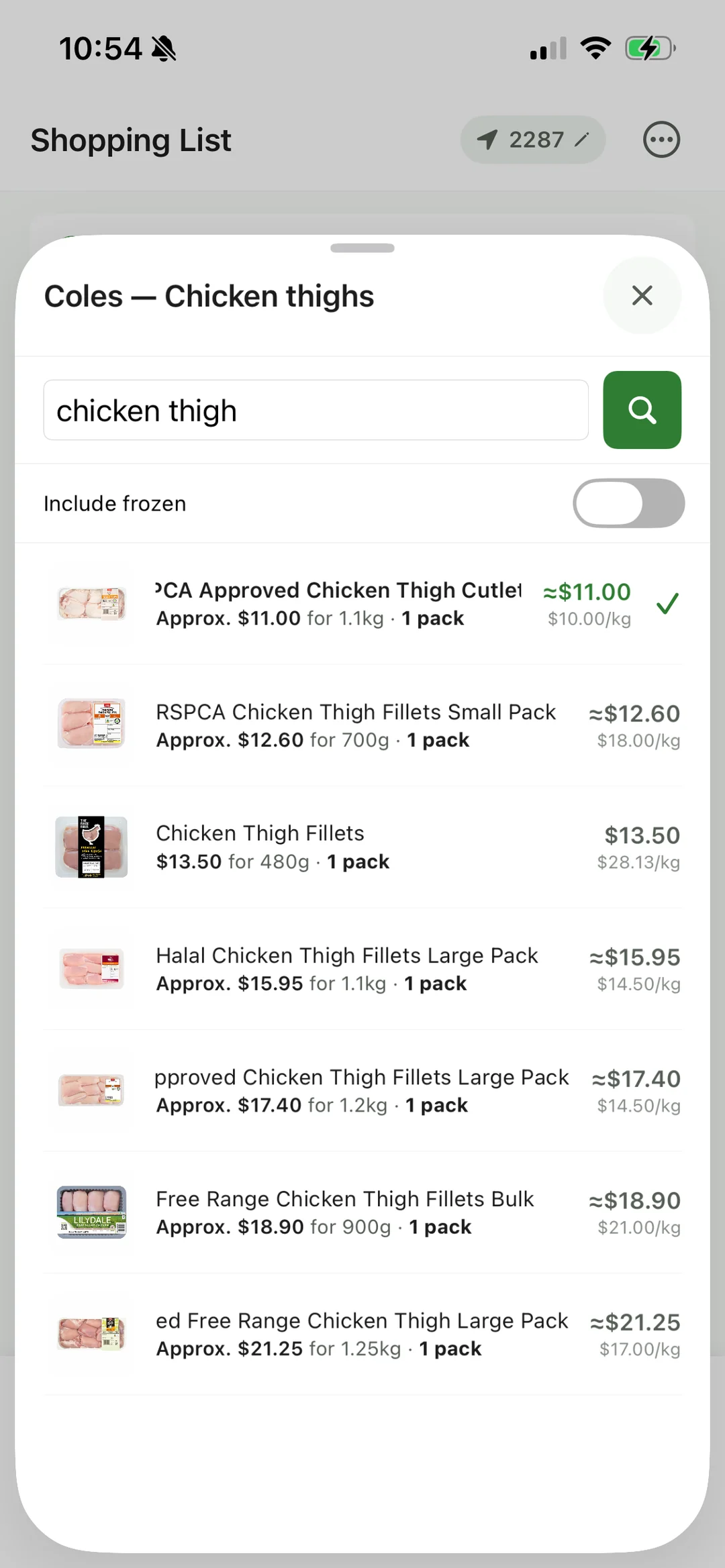
Tap any price to see the product behind it and the alternatives at that store. Check the cut, the preparation, the pack size and the unit price before you accept the match.
Here the list asks for chicken thighs, and the Coles match is RSPCA Approved Chicken Thigh Cutlets at about $11.00 for 1.1 kg, or $10.00 a kilogram. The thigh fillets run from $14.50 to $28.13 a kilogram. Thigh cutlets are usually sold bone-in, so part of that cheaper kilogram can be bone. Neither is wrong, but they are not the same buy.
Choose the product that suits the recipe, then compare its price. The app remembers your choice for next time.
See whether a split shop is worth it
Switch to Cheapest mode and the matched items regroup by whichever store has the lowest displayed price for each one.
Here the ALDI group holds 16 items for $31.07, the part of the list where ALDI is cheapest. Some of those wins are a single cent, like avocado at $2.49 against $2.50; others are worth more, like broccoli at about $1.53 against $1.95 at Woolworths. Look at the other store groups and the missing items before deciding whether a second stop is worth the drive.
Count the extra trip, delivery fees and your time before you split the shop.
Try it with your groceries
Price the list you’re actually buying.
Free to download on iPhone and Android, no ads, no account to create. The free tier prices three items on your list, enough to see how the matching works. Pro prices the whole list and remembers the products you pick.


Prices are estimates for your selected stores. Check the final price and availability with the retailer.
Start with dinner
The list starts with what you are cooking
Save the recipes you want to cook, give each one a day, then generate the shopping list from the plan. The comparison then prices the week you have actually planned. Follow the recipe-to-list guide
1. Bring a recipe in
From a website link, a photo, a TikTok or YouTube video, or copied text.
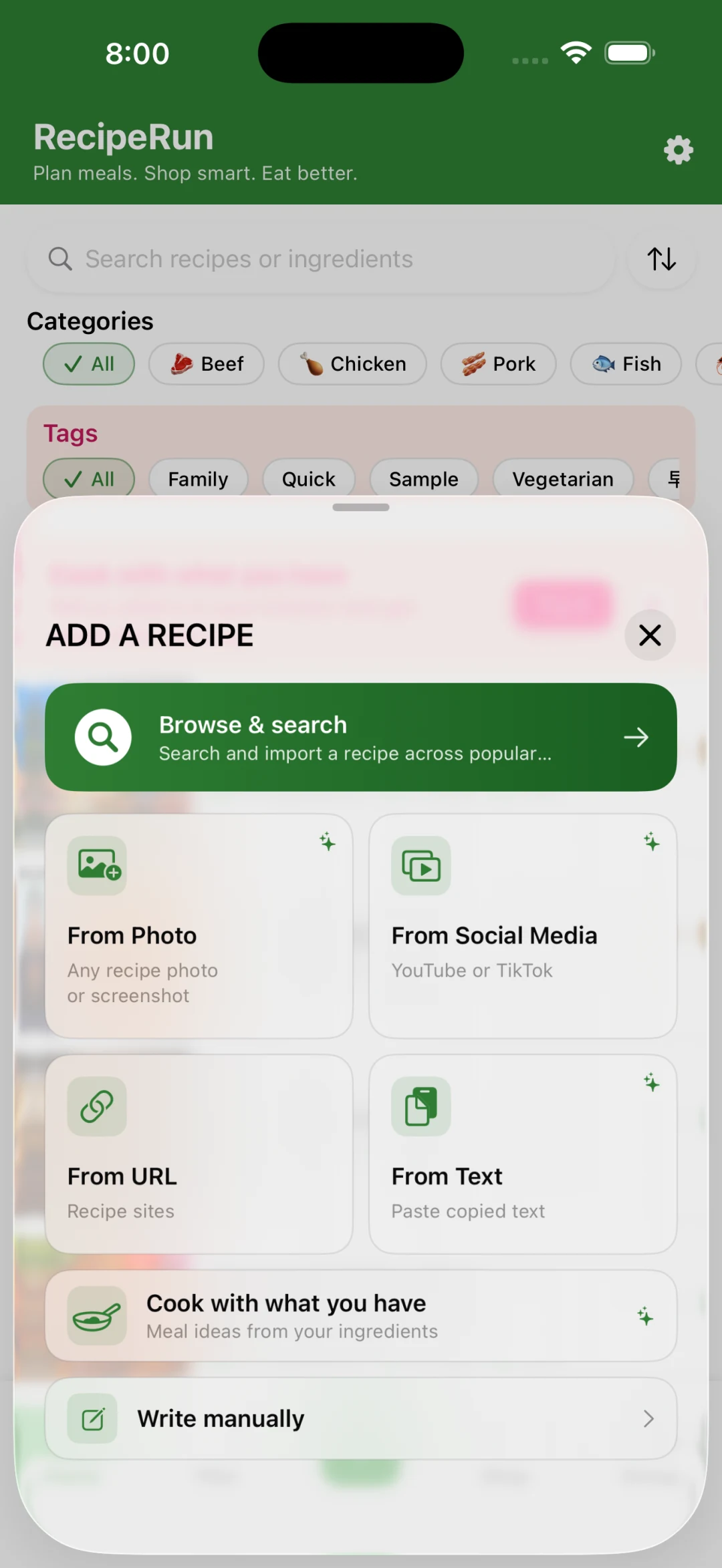
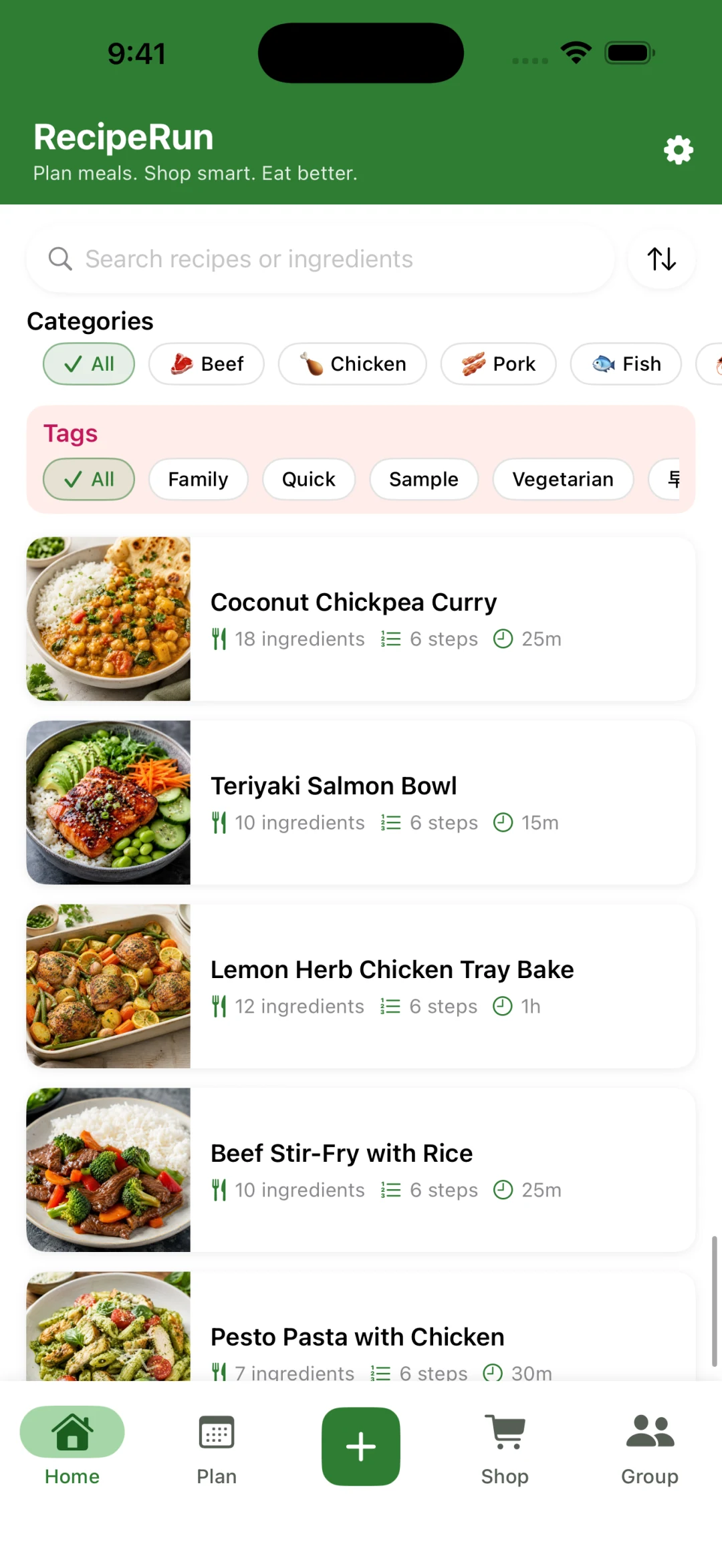
2. Keep your favourites together
Search, categories and tags, so you cook from your own collection again.
3. Put dinner into the week
Choose the meals and servings for each day, then generate the list.
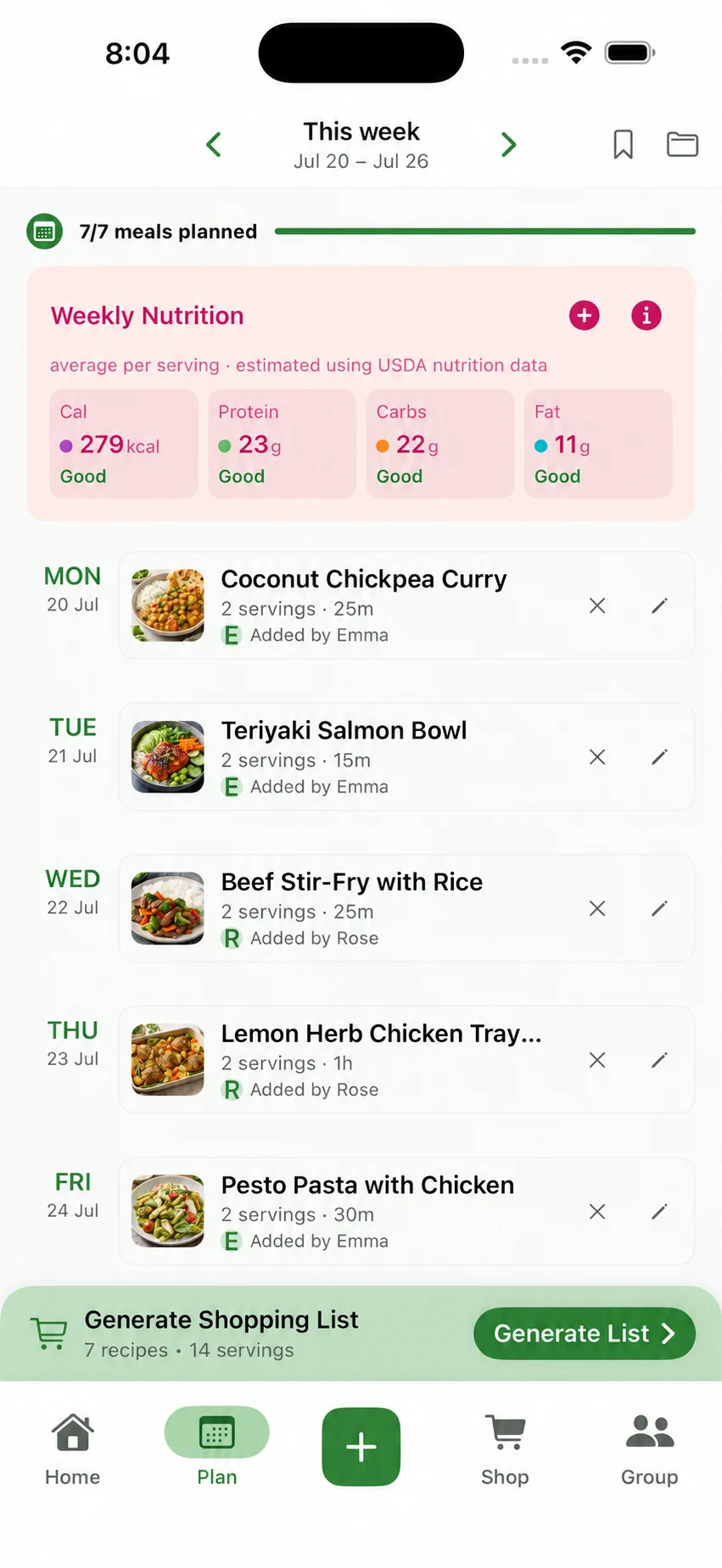
These three screens show the recipe and planning features with a sample week. The 43-item comparison above was generated from the same sample recipes in a later week.
Put the prices in context
What the independent research says
A supermarket survey is a useful benchmark for the market as a whole. Your household’s products and quantities still decide what your shop costs.
CHOICE’s March 2026 supermarket survey
CHOICE’s March 2026 survey priced a 16-item basket at 104 supermarkets across 27 Australian locations. The results page was updated on 25 June 2026.
Swipe horizontally to compare
| Supermarket | Without specials | With specials |
|---|---|---|
| ALDI | $68.60 | $68.60 |
| Woolworths | $77.53 | $76.82 |
| Coles | $78.58 | $78.50 |
On that basket ALDI came in $8.22 under Woolworths and $9.90 under Coles after specials. Swap in your own brands, quantities and local availability and the gap can shrink, grow or reverse, which is the whole reason to price your own list.
Source note: CHOICE’s detailed table gives ALDI $68.60; one sentence on the same page says $68.80. We use the table figure. These are March survey results and have nothing to do with the RecipeRun example above.
Our July 2026 shelf-price spot checkNine everyday products with source links. Historical prices, kept for the record.
July 2026 shelf-price spot check
We checked Coles and ALDI product pages on 12 July 2026 and Woolworths on 13 July 2026, with pick-up set to Woolworths Town Hall, Sydney NSW 2000. Coles had no confirmed location; the ALDI pages resolved to Glenmore Park NSW 2745.
These are historical observations from different locations. They are not added into a basket total and they have not been refreshed since July.
Swipe horizontally to compare
Matching notes: the eggs are not like for like: ALDI’s are caged, Coles’s cage-free and Woolworths’s barn-laid. ALDI’s rice is a 2kg pack against two 1kg packs, all three at about $1.80 a kilogram. The vegetable mixes and the mince grades may differ too.
Five of the original Woolworths products were unavailable at Town Hall, so the table shows the closest same-size alternatives on sale there for milk, spaghetti, frozen vegetables, eggs and mince.
Three habits that keep a comparison honest
Compare the unit price as well as the pack price
A bigger pack can be cheaper per kilogram and dearer at the checkout. Compare on a common measure, dollars per litre or per 100 grams, then ask how much you will actually use before it goes off. The ACCC’s unit-pricing guide explains how to read the shelf labels.
Check the conditions on the price
Compare at roughly the same time, for the same area and the same way of shopping. A price that needs a loyalty card or a two-for deal only counts if you would buy that way anyway, and an online shop is not cheaper until the delivery and service fees are in.
Keep the products the same
Write down the products and quantities before you start looking at prices, and hold the brand tier and the specification steady. Cage and cage-free eggs are different products; so are different grades of mince. If a store has nothing equivalent, leave the item marked missing rather than forcing a match. More on this in how ingredients match supermarket products.
Common questions about supermarket prices
Which app compares Woolworths, Coles and ALDI prices?
RecipeRun. Choose your local stores by postcode and your grocery list shows an estimated total at each, the product behind every price and a count of anything it could not match. You review the matches and the gaps before you shop.
Is the price comparison free?
Partly. RecipeRun is free to download with no ads and no account to create, and the free tier prices three items on your list so you can see how the matching works. Pro prices the whole list, remembers the products you choose, and includes Family Groups and unlimited recipe imports.
Which is cheapest: Woolworths, Coles or ALDI?
ALDI, for CHOICE’s 16-item basket in March 2026. For your list, nobody can say until it is priced, because brands, quantities, stores and specials all move the answer. For the 43-item list in our walkthrough, on that day’s estimates, it was Woolworths. Price your own basket and count the missing items before calling a lower total a saving.
Why are some items missing from a store’s total?
Because the app found nothing at that store it was confident matched the ingredient. Tap the missing-item count to see which ones, then either pick a product yourself or accept that the store does not stock it. A lower total with more missing items is not a like-for-like saving.
How do I compare different pack sizes?
Compare the unit price of similar products first, then check the pack size against the amount you will actually use. A cheaper kilogram is only a saving if the bigger pack does not end up in the bin.
Are these live checkout prices?
No. They are estimates that can be cached or incomplete, and the shelf price on the day is the one that counts. The screenshots in this guide were captured on 30 September 2026 and show that day’s estimates. Confirm product, availability and price with the retailer. The price-data section of our Terms sets out the limits.
How often do supermarket prices change?
Regular prices move occasionally and specials move weekly, and both can differ between stores and between in-store and online shopping. Check again close to the day you shop.
Is splitting the shop across two stores always cheaper?
Not once you count the drive, the delivery fees, your time and the items only one store had. Cheapest mode shows you the store groups so you can decide whether the second stop is worth it for your list.
Sources and disclosure
- CHOICE supermarket survey: March 2026 fieldwork; results page updated 25 June 2026.
- ACCC guidance on grocery unit pricing.
- Retailer product pages linked in the July spot check: Coles and ALDI accessed 12 July 2026, Woolworths 13 July 2026.
- Walkthrough screenshots captured on iPhone on 30 September 2026 from a 43-item list generated from a week of sample recipes, at Woolworths Maryland, Coles Fletcher and ALDI Fletcher (NSW 2287). The totals shown are that day’s estimates for whole packs, and no retailer checkout was completed. Two screens are edited: the opening image is cropped from the Compare row with a tip removed and the rows below joined from a second capture, and the Cheapest mode screen has its filter controls and the tip removed with the list extended the same way. No price or label was changed. The recipe and planning screens are earlier captures of the same app.
This guide is written by the team that makes RecipeRun, so it is not an independent review. RecipeRun is not affiliated with, authorised by or endorsed by Woolworths, Coles or ALDI. Retailer names and trademarks belong to their owners.
Originally published . Last updated .
Put next week’s shop in one place.
Save your recipes, plan your meals and price your grocery list at your local Woolworths, Coles and ALDI. Free to start, no ads, no account.