
Grocery savings
Why a Generic Grocery Basket Differs From Your Real Basket
A reproducible framework for comparing a standard benchmark with a preference-aware household basket.
Quick answer: A generic grocery basket is useful for comparing supermarkets under one consistent method, but it may not predict the cheapest shop for your household. Your brands, dietary requirements, pack sizes, local stores, specials and preferred substitutes can change both the eligible products and the total. Use independent basket studies as a benchmark, then compare the products you would genuinely buy.
This article explains the difference without presenting invented prices or savings. The worksheet below is a method for a future measured comparison, not a live basket result.
What is a generic grocery basket?
A generic basket is a fixed set of products selected so the same basic shop can be priced across retailers. Researchers define the items, pack-size rules, acceptable substitutes, locations and treatment of specials before calculating an average or total.
CHOICE's March 2026 survey, for example, priced a 16-item basket at 104 supermarkets in 27 Australian locations. CHOICE selected products for similarity in pack size and ingredients and considered product specifications and packaging. It describes the result as a general picture, not the whole picture.
That disciplined design makes the survey useful. It answers a question such as: under this basket and method, which chain had the lowest average result? It does not answer: which store will be cheapest for every household's next shop?
What is a real household basket?
A real basket contains the items a particular household is willing and able to buy. It includes choices a generic benchmark may deliberately set aside:
- Preferred brands and flavours.
- Dietary, allergen, religious or ethical requirements.
- The pack sizes the household can store and finish.
- Products acceptable to children or other family members.
- Local stock and the stores that serve the household's postcode.
- Loyalty offers the shopper can genuinely use.
- Pantry stock and the quantities required by the current meal plan.
- The time, travel and fees involved in splitting a shop.
Two households can start with the same grocery name and still need different products.
An illustrative specification worksheet
This table contains no retailer prices and no measured result. It shows why a generic product description may not represent a particular shopper's choice.
Swipe horizontally to compare
| Grocery need | Possible generic-basket rule | Possible household specification | Why the eligible products change |
|---|---|---|---|
| Milk | Own-brand full-cream milk in a standard pack | Lactose-free milk in the household's usual size | Standard dairy milk is not a suitable substitute |
| Eggs | Closest standard dozen by weight | Free-range eggs only | Production method removes some cheaper matches |
| Rice | Similar own-brand long-grain pack | Preferred basmati brand in a larger pack | Variety, brand and pack size differ |
| Pasta | Lowest suitable dried pasta in a standard pack | Gluten-free spaghetti | Ingredient and dietary specifications differ |
| Yoghurt | Similar plain dairy yoghurt | Dairy-free, unsweetened yoghurt | Product category and pack options change |
| Mince | Closest comparable beef mince pack | A chosen fat level or production standard | Products with different specifications may not be interchangeable |
| Laundry detergent | Standard pack selected for comparison | Sensitive-skin formulation | Household suitability changes the valid range |
These are examples of specification differences, not a claim that any listed preference is cheaper or more expensive.
How preferences can reverse a supermarket result
A chain can perform well in a generic comparison because it has low-priced matches for the study's defined products. A household result may move when:
- Its required product is unavailable at that chain.
- The preferred brand is promoted elsewhere.
- A larger pack has better unit value but a higher checkout price.
- A dietary substitute has a very different retailer range.
- Several generic matches become unmatched under stricter specifications.
- Delivery fees, minimum spends or extra travel are included.
The correct conclusion is not that a generic survey is wrong. The generic and household baskets answer different questions.
Generic basket and preferred basket should work together
Use each comparison for the job it does well:
Swipe horizontally to compare
| Comparison | Best use | Main limitation |
|---|---|---|
| Independent generic basket | A consistent benchmark of broad retailer pricing under a published method | May not contain the products your household buys |
| Your preferred basket | Planning a particular shop around real requirements | More personal, harder to reproduce nationally and sensitive to local availability |
| Cheapest acceptable basket | Finding the lowest current total among products you are willing to substitute | Requires clear minimum specifications and careful matching |
| Split-store basket | Seeing the lowest displayed item subtotal across several stores | Extra time, travel, fees and unmatched items can remove the practical benefit |
A useful shopping routine begins with independent evidence, then narrows the comparison to suitable local products.
How to run a credible real-basket comparison
Define the basket before looking at prices
Write down the grocery name, required quantity and minimum acceptable specification first. Do not change the basket after seeing which store looks cheaper unless the substitution rule allows it.
Record exact products
For each retailer, keep the product name, brand, pack size, retailer link and any material specification. If no acceptable equivalent exists, mark the item unmatched rather than choosing a convenient substitute.
Hold location and shopping method constant
Select stores serving the same postcode and check them within a short period. Do not combine an unlocalised catalogue price for one retailer with a selected-store pick-up price for another.
Separate promotions from ordinary prices
Record whether a price is an ordinary price, temporary special, loyalty offer or multi-buy. Only apply an offer if the household is eligible and would buy the required quantity.
Keep unit price and checkout price
The ACCC's unit-pricing guidance explains how a standard unit helps compare similar products across sizes and brands. Unit price answers a value question; pack price answers the immediate budget question. Keep both.
Report completeness
Show how many items were matched and which were missing. A subtotal covering eight of ten products must not be presented as cheaper than a complete ten-item basket without adjustment.
Add practical costs
If the comparison suggests splitting the shop, include delivery or service fees, travel and the value of the extra time. The lowest product subtotal is not automatically the best household decision.
Evidence template for a publishable comparison
Record these fields for every observed product:
Swipe horizontally to compare
| Field | What to record |
|---|---|
| Basket version | A fixed name or version so later updates do not silently change the products |
| Grocery specification | Food, form, quantity, minimum requirements and substitution rule |
| Exact product | Retailer product name, brand and pack size |
| Location | Postcode, selected store and fulfilment method |
| Timing | Date, time and timezone of access |
| Price status | Pack price, unit price, ordinary or promotional, and loyalty eligibility |
| Availability | In stock, unavailable, substituted or unmatched |
| Source | Direct retailer link or dated in-store evidence |
| Calculation | Quantity of packs required and treatment of surplus |
| Practical costs | Delivery, service fees, travel assumptions and minimum spend |
Publish the method beside the result. Do not refresh the date unless the products and observations were actually rechecked.
Why remembered product preferences are a genuine advantage
Choosing exact products for every weekly comparison creates friction. If a grocery app remembers that “milk” means the household's usual lactose-free 2 L product, or that “rice” normally maps to a particular variety and pack, later baskets can begin closer to reality.
That provides three genuine benefits:
- Less repeated product matching from one shop to the next.
- A comparison that increasingly reflects the household's accepted products.
- Clearer exceptions when the preferred item is unavailable and a substitute needs review.
The advantage is personal relevance, not guaranteed savings. Preferences can become outdated, a different pack may become better value, and the selected product can be unavailable. Users should be able to review and change remembered choices.
How RecipeRun supports a preferred basket
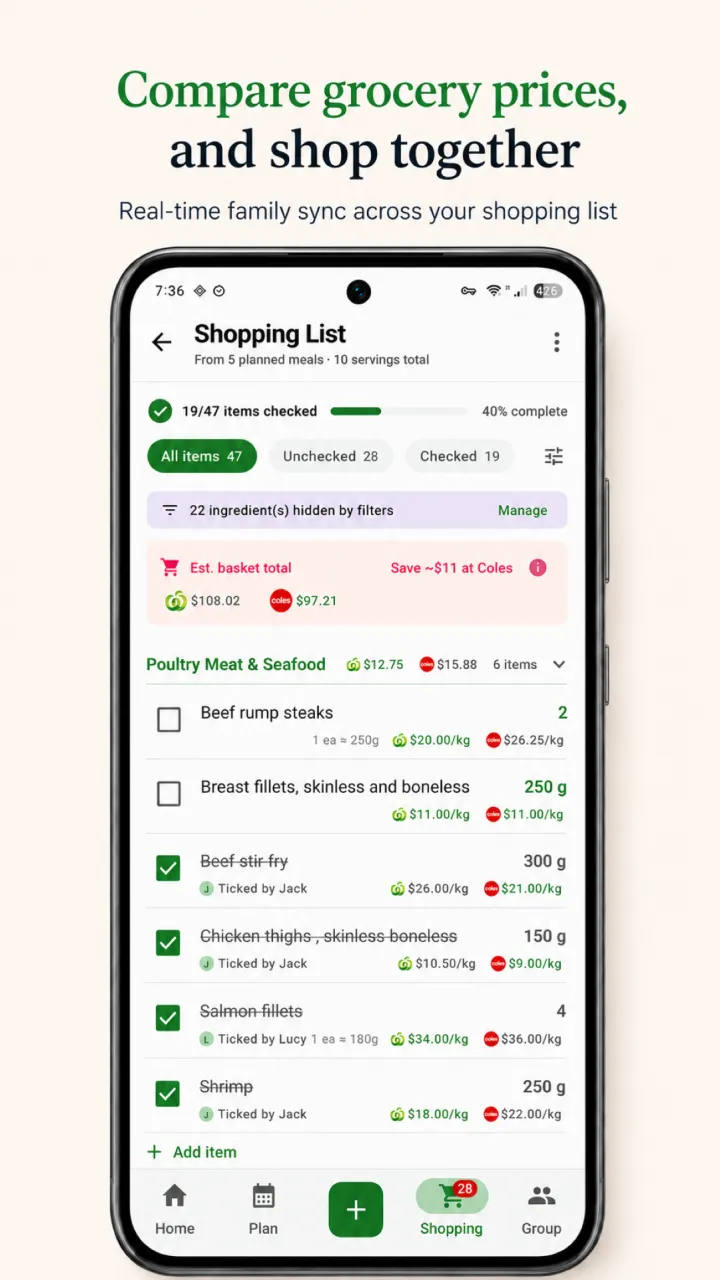
RecipeRun begins with ingredients from saved recipes, the weekly meal plan and the grocery list. In Australia, it can show indicative prices for selected matched products at Woolworths, Coles and ALDI stores chosen by the user.
For each grocery item, the user can customise the grocery name, review the product match and choose a preferred product or variant. RecipeRun remembers that preference for future grocery runs. As genuine choices accumulate, the basket can represent the household's usual shop more closely than a default generic match.
RecipeRun also offers:
- One-stop comparison for displayed matched products at selected stores.
- Cheapest Mode for grouping matched items by the lowest displayed price when the shopper is willing to split the shop.
- Family Groups for sharing recipes, the plan and grocery list with the household.
Prices are indicative only and may be cached, incomplete, out of date or different at checkout. Not every item has an equivalent at every retailer, and RecipeRun does not operate a central retailer price database. Review selected and unmatched products, then verify prices with the retailer. Full details appear in the RecipeRun Terms.
Frequently asked questions
Are generic grocery basket studies useful?
Yes. A well-designed independent basket provides a consistent benchmark across stores and locations. Its result applies to the specified basket and method, not automatically to every household.
What is a personalised grocery basket?
It is a list of the products, pack sizes and acceptable substitutes a household would genuinely buy, usually for a defined meal plan or shopping period.
Does a preferred basket always cost more than a generic basket?
No conclusion can be made without current, like-for-like observations. Some preferred products may cost more, some may be on promotion, and some generic matches may be unavailable. This article contains no measured price result.
Can the cheapest supermarket change for my basket?
Yes. Product preferences, availability, local prices, promotions and fees can produce a different result from a national or generic benchmark.
Does RecipeRun guarantee the cheapest shop?
No. RecipeRun is a planning and comparison aid. Displayed prices are indicative, and product matching, availability, travel and checkout prices require review.
Build a comparison around what you actually buy
Start with our evidence-led guide to comparing Woolworths, Coles and ALDI prices, then see how recipe ingredients are matched to supermarket products.
You can explore RecipeRun as a recipe manager with a grocery list, or download it free on Google Play and the App Store.
Sources and disclosure
- CHOICE supermarket price survey, updated 25 June 2026 and accessed 13 July 2026.
- ACCC guidance on grocery unit pricing, accessed 13 July 2026.
This article is published by the team that makes RecipeRun. The specification worksheet is illustrative and contains no observed supermarket prices, basket totals or claimed savings. RecipeRun is not affiliated with, authorised by or endorsed by Woolworths, Coles or ALDI.