
Grocery savings
How Recipe Ingredients Become Real Supermarket Products
A transparent look at product matching, user corrections and why a preferred household basket differs from a generic one.
Quick answer: A recipe ingredient such as “500 g pasta” is not yet a supermarket product. A useful match must resolve the food type, form, required quantity, pack size and any brand or dietary preference before comparing available products. RecipeRun lets Australian users review the selected product for a grocery item and remember a preferred choice for later shops, but every match and price still needs checking.
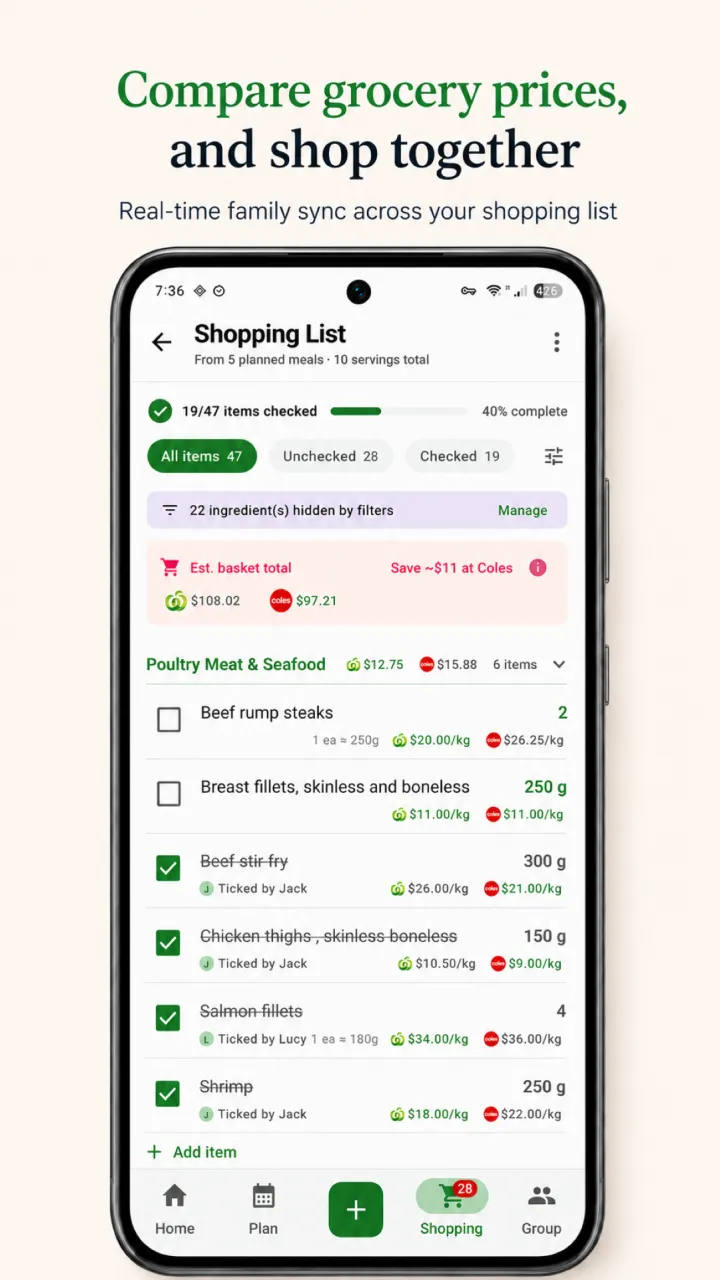
This gap between an ingredient and a product explains why grocery comparison is harder than searching for the cheapest word on a retailer's website.
Ingredient, grocery item and product are different things
Consider three levels of information:
Swipe horizontally to compare
| Level | Example | What it tells us |
|---|---|---|
| Recipe ingredient | 500 g pasta | The recipe's required food and quantity, but not necessarily its shape or brand |
| Reviewed grocery item | Dried spaghetti, 500 g | The shopper has resolved the form and quantity |
| Supermarket product | A particular 500 g packet of dried spaghetti | The exact item with a retailer, pack, price and availability |
Comparing prices at the first level can produce poor matches. Penne, fresh ravioli, gluten-free spirals and dried spaghetti may all contain the word “pasta”, but they are not substitutes for every household or recipe.
A worked 500 g pasta example
The following is an illustrative matching worksheet, not a live retailer lookup and not a price comparison.
Swipe horizontally to compare
| Question | Possible answer for this shop | Why it matters |
|---|---|---|
| What pasta shape does the recipe require? | Spaghetti | A broad “pasta” result could select the wrong form |
| Fresh or dried? | Dried | Fresh pasta has different storage, cooking and pack conventions |
| How much is needed? | 500 g | The chosen pack must cover the planned quantity |
| Dietary requirement? | No special requirement | Gluten-free or allergen requirements must never be inferred casually |
| Brand preference? | Household's usual brand, if available | A cheaper generic product may not represent what the household would buy |
| Store and location? | One selected local store per retailer | Price and availability can depend on location and shopping method |
| Promotion allowed? | Record separately | A temporary or loyalty offer is not the same as an ordinary price |
Only after those questions are resolved does it make sense to compare suitable products.
The matching factors that matter most
Food identity and form
The match should preserve distinctions that affect the recipe: plain versus self-raising flour, fresh versus ground ginger, tomato paste versus diced tomatoes, or chicken breast versus thigh.
Required quantity and pack size
A recipe quantity and a retail pack are not the same thing. If a recipe needs 600 g and the relevant products come in 500 g packs, one pack is insufficient. If another product comes in 1 kg, it may have a lower unit price but a higher checkout cost and leave a surplus.
Dietary and product specifications
Lactose-free, gluten-free, halal, kosher, vegan, nut-free and other requirements can determine whether a product is suitable. Production methods and quality preferences can matter too: cage, barn-laid and free-range eggs are not exact equivalents.
Never rely on an automated name match for allergy or medical decisions. Read the current product label and obtain professional advice where appropriate.
Brand and household preference
Generic basket studies usually choose comparable products according to a fixed method. A household may instead buy a particular brand, flavour, fat level or pack because of taste, dietary needs, value at its rate of use, or simple habit.
Remembering that product preference is useful because the next comparison starts closer to the shopper's real decision. It does not guarantee the product is cheapest or available.
Unit price and the amount paid
The ACCC explains that unit pricing uses a standard measure such as price per kilogram, litre or item to help compare similar groceries. It is essential when pack sizes differ.
Keep both numbers:
- Unit price helps compare value across compatible sizes.
- Pack price is the amount paid at checkout.
A larger pack can be better value per kilogram but still be the wrong choice if it exceeds the budget, will not be used, or requires buying much more than the recipes need.
Location, time and availability
An exact product can be in stock at one store and unavailable at another. Prices and promotions can change by location, fulfilment method and time. A credible comparison therefore records the selected store or postcode, access time, product link, promotion status and availability.
Why the cheapest text match is not enough
An automatic system that simply picks the lowest result containing an ingredient word can make several errors:
- Select a different food form.
- Compare unequal pack sizes without using unit prices.
- Ignore a dietary or brand requirement.
- Use an unavailable product.
- Treat a multi-buy, loyalty offer or expired special as an ordinary price.
- Omit unmatched items and make an incomplete store subtotal look lower.
The honest response to an uncertain match is to ask for review or mark it unmatched, not silently force a substitute.
What independent basket research teaches us
CHOICE's March 2026 supermarket survey selected products for similarity in pack size and ingredients and also considered specifications and packaging. When an item was unavailable, its fieldworkers looked for the closest alternative. CHOICE still cautions that a basket provides a general picture rather than the whole picture because prices, ranges and specials change.
That is a strong model for personal comparisons too: define the intended item, record the substitution rule and disclose where matches are imperfect. Read our detailed guide to comparing Woolworths, Coles and ALDI fairly.
How RecipeRun uses your reviewed choices
RecipeRun starts with ingredients from your saved recipes, meal plan and grocery list. For Australian users, it can show indicative prices for selected matched products at Woolworths, Coles and ALDI stores they choose.
You remain in control of the grocery item and product choice:
- Customise the grocery name so it reflects what you intend to buy.
- Review the selected product at each store rather than trusting a generic label.
- Choose a preferred product or variant for a grocery item.
- Let RecipeRun remember that preference for later grocery runs.
- Review unmatched or unavailable products before comparing totals.
As more genuine preferences are saved, the basket can better represent the household's usual products instead of restarting from default matches every week. This is a practical personalisation advantage, but it does not turn indicative prices into a guarantee.
RecipeRun does not operate a central retailer price database. Price retrieval is initiated by the user for personal use, and displayed prices may be cached, incomplete, out of date or different at checkout. See the price-data terms and limitations.
A product-match review checklist
Before accepting a match, confirm:
- Identity: Is it the same food and form?
- Quantity: Does the pack cover the amount required?
- Specification: Does it meet dietary, allergen and household requirements?
- Preference: Is it the product the household would actually choose?
- Value: Are both unit price and pack price visible?
- Offer: Is the price ordinary, promotional, loyalty-only or multi-buy?
- Location: Is the correct local store and shopping method selected?
- Availability: Can the product actually be purchased?
- Completeness: Are unmatched items clearly shown?
Frequently asked questions
Can a recipe app choose the exact supermarket product for me?
It can suggest or remember a product, but you should review the match. Recipe wording is often ambiguous, product ranges change and personal requirements cannot always be inferred safely.
Is unit price enough to choose a grocery product?
No. Unit price helps compare value among similar products, but you must also consider pack cost, required quantity, product suitability, likely waste and availability.
Why remember a preferred product?
It reduces repeated matching work and makes future comparisons more representative of the products a household normally buys. The preferred item can still be unavailable or more expensive in a later shop.
Does RecipeRun guarantee supermarket prices?
No. RecipeRun displays indicative information for selected products. Retailer availability and the price charged at checkout prevail.
Compare products for the list you actually plan to buy
Explore RecipeRun's recipe manager and grocery list features, then read why a generic basket and a real household basket can produce different comparisons.
RecipeRun is free to download on Google Play and the App Store.
Sources and disclosure
- ACCC guidance on grocery unit pricing, accessed 13 July 2026.
- CHOICE supermarket price survey, updated 25 June 2026 and accessed 13 July 2026.
This guide is published by the team that makes RecipeRun. The pasta worksheet explains matching decisions and contains no observed retailer prices or measured savings. RecipeRun is not affiliated with, authorised by or endorsed by Woolworths, Coles or ALDI.