
Recipe organisation
How to Digitise Handwritten Recipe Cards Without Retyping Them
A careful photo, extraction and verification workflow for preserving handwritten recipes without relying on blind automation.
Quick answer: Photograph the whole recipe card in even light, keep the camera parallel to the paper, retain a high-quality image of every side, and use photo-to-recipe extraction to create a working copy. Then compare every ingredient, quantity, temperature, time and instruction with the card before cooking. Never guess at unclear handwriting.
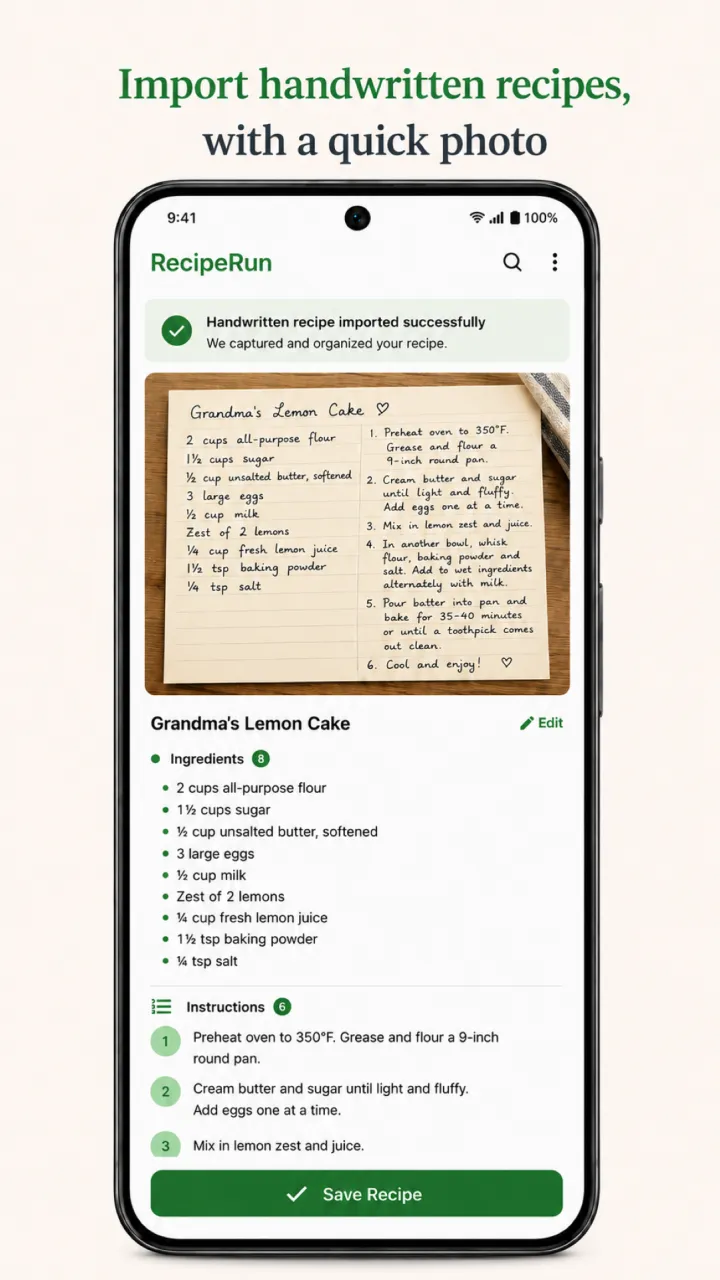
Digitising a handwritten recipe has two jobs. One is preservation: keeping a faithful image of the original card and its history. The other is usability: turning the writing into a recipe that can be searched, planned and added to a grocery list. An extracted recipe can help with the second job, but it does not replace a careful preservation copy.
Before you photograph the card
Check whether it is safe to handle
Place the card on a clean, dry and uncluttered surface. Handle it gently by the edges and do not force a folded, brittle or torn card flat. Remove loose dust only if you can do so without rubbing away pencil, ink or the paper surface.
The National Archives of Australia’s preservation guidance cautions against applying pressure to fragile mounted material and recommends seeking conservation advice for records in poor condition. A family recipe card may not need institutional treatment, but the same principle applies: getting a flatter photo is not worth damaging the original.
Record what the image alone cannot explain
Before memories are lost, note what your family knows about the recipe:
- Who wrote or used the card.
- The name your family calls the dish.
- An approximate date or occasion, if known.
- Whether notes were added by different people.
- Whether “a cup”, “a tin” or an oven setting had a household-specific meaning.
- Whether another card contains the missing continuation.
Keep uncertain details marked as uncertain. A question mark is more truthful and useful than an invented date or attribution.
Confirm you may store and share it
If the recipe came from a published book, magazine or another person, the card may include copyright material or private family information. RecipeRun imports are for personal use, and sharing remains your responsibility. IP Australia explains that copyright protects original expression automatically in Australia.
How to take a clear recipe-card photo
Use even light
Photograph the card near a bright window or under diffuse room lighting. Move lamps or the card until there is no glare across glossy ink, laminated surfaces or food stains. Avoid a hard shadow from your phone.
Flash can flatten faint pencil in some situations but create glare and blown highlights in others. Take a non-flash image first and inspect the smallest writing at full size. If the text is not legible, change the light or camera position rather than applying filters that could remove faint marks.
Keep the camera parallel
Place the card flat only if it can rest safely. Hold the phone directly above it so all four edges appear as a rectangle rather than a trapezoid. Leave a small border around the card, tap to focus on the writing and hold still until the photo is captured.
A neutral, contrasting background helps you see the card’s edges. For loose photographs, National Archives digitisation procedures use a plain white background to create consistent captures. For a pale recipe card at home, a darker neutral background may make its boundary easier to confirm, provided it does not introduce colour or reflections.
Capture the complete object
Photograph the front and back, even if the reverse appears blank at first glance. Look for ingredients written in a margin, an oven temperature on the top edge, substitutions on the back and arrows that change the instruction order.
If the card is inside an album or attached to another page, do not detach it merely to improve the image. Photograph it in place or ask a conservator for advice if the attachment is obscuring important text.
Inspect before putting the card away
Zoom in and check the hardest sections while you still have the setup ready. Confirm that:
- Every edge and corner is visible.
- Small fractions and decimal points are sharp.
- “tsp” and “tbsp” can be distinguished.
- Temperatures and timing notes are not cut off.
- Pale pencil and crossed-out text remain visible.
- Images are the right way up and clearly named front or back.
Retake the photo immediately if any critical line is blurred. Image enhancement cannot reliably recreate information the camera did not capture.
Create a working recipe without typing every line
RecipeRun can use a photograph of a handwritten card to extract a title, ingredients, serving size, cooking times and instructions. The image is sent securely for processing and may be handled by a third-party AI provider, as described in the RecipeRun Privacy Policy.
Use the extraction as a draft:
- Open the photo-import option and choose the clearest image.
- Let RecipeRun create the structured recipe.
- Keep the original card or full-resolution image open beside the result.
- Correct the extracted fields before saving or cooking.
- Retain the preservation image separately from the working recipe.
Photo import is subject to free or Pro monthly limits. It is designed for recipe pages, cookbooks and handwritten recipes, not for private documents or general-purpose archiving.
The line-by-line verification checklist
AI can misread neat handwriting as well as difficult handwriting. Fractions, abbreviations and cooking temperatures deserve particular attention.
Swipe horizontally to compare
| Check | Common ambiguity | Safe response |
|---|---|---|
| Recipe title | Family nickname interpreted as an ingredient | Compare the heading and family context |
| Quantity | 1/2 read as 1 1/2, or a faint fraction lost | Zoom into the original; mark unclear if unresolved |
| Unit | tsp read as tbsp | Check handwriting elsewhere on the card for comparison |
| Ingredient | “cornflour” confused with “corn flour” or another word | Use the original spelling unless context confirms otherwise |
| Temperature | Celsius, Fahrenheit or an old gas mark omitted | Preserve the written scale; do not convert without recording it |
| Time | 15 read as 75, or resting time merged with cooking time | Check the numeral and its place in the method |
| Sequence | Margin arrow or “add later” note missed | Rebuild the instruction order from the whole card |
| Yield | “serves 6” confused with a step number | Keep servings separate from instructions |
Read the ingredients once on their own, then read the method and account for each ingredient. If the method mentions an ingredient missing from the list, do not automatically add a guessed quantity. Record the discrepancy and investigate it.
Resolve old measurements without erasing the original
Family recipes may use a “small tin”, a particular teacup, imperial measures or an oven description rather than an exact modern unit. Keep the original wording in your preservation copy.
For the working recipe:
- Ask the original cook or another family member where possible.
- Look for a matching version written elsewhere by the same person.
- Record a tested interpretation separately from the original wording.
- State the source of any conversion or substitution.
- Avoid presenting an estimate as if it appeared on the card.
If food safety depends on a temperature, time or ingredient and the card is unclear, use an appropriate current food-safety source or a reliable modern recipe rather than relying on a guess. RecipeRun is an organisation tool and its extracted content is not medical, dietary or food-safety advice.
Preserve the story as well as the method
A perfectly formatted ingredient list can still lose what made the card meaningful. Keep a high-quality image showing the handwriting, stains, annotations and both sides. Use descriptive file names rather than a camera sequence alone; for example, include the family name, dish and whether the image is the front or back.
The State Library of New South Wales recommends organising and labelling family records, scanning at a high resolution and using a consistent file-naming convention. Its guidance is written for family-history records generally, and the same habits help keep recipe-card images understandable.
Do not rely on the extracted text as the only digital record. It captures the recipe’s structure, not necessarily the object’s appearance or every uncertain mark.
Store the physical card after digitising
Return the card to a stable, dry storage location away from direct sunlight, food preparation, steam and frequent handling. Use archival-quality materials if the card is valuable and seek specialist advice if it is mouldy, badly torn or actively deteriorating.
Digitisation reduces the need to handle an original, but it does not stop the physical object ageing. It also does not guarantee the digital copy will survive. Keep more than one copy of important images and periodically confirm that the files still open.
Privacy and AI limitations
RecipeRun photo import can be convenient, but it is not offline transcription. Submitted images may be processed by third-party AI providers such as Anthropic, Google or OpenAI. RecipeRun states that uploaded photos are not used to train AI models and are not intentionally retained after processing, except where temporarily required for processing, security, debugging or legal compliance. Extracted text may be temporarily cached for up to 24 hours.
Avoid uploading images containing people, addresses, financial information, private correspondence or other sensitive material. Crop or photograph the recipe separately where doing so is safe for the original.
AI output may be incomplete or wrong. You remain responsible for reviewing ingredients, allergens, quantities, times and instructions before using the recipe. See the current Privacy Policy and Terms rather than relying on this summary if the processing details affect your decision.
Organise the extracted recipes
Once each working copy is verified, give it the name your household would naturally search for and keep the family attribution where it helps distinguish versions. Add it to the same library as your website and photo recipes instead of creating a separate digital attic.
The broader guide How to Organise Recipes Digitally explains how to choose a working library, retain sources and migrate recipes in manageable batches.
RecipeRun can keep the extracted recipe in a searchable library, add it to a weekly meal plan and use its ingredients to generate a grocery list. Explore the recipe manager with grocery list, then download RecipeRun free from Google Play or the App Store.
Other apps that scan handwritten cards, such as Recipe Keeper and ReciMe, are covered in our recipe manager app comparison for Australia.
Frequently asked questions
Can an app read a handwritten recipe card?
RecipeRun can use AI photo extraction to turn handwriting into structured recipe fields, but the result is not guaranteed to be accurate. Image quality, handwriting, abbreviations and card condition all affect what can be read. Verify the result against the card.
What should I check after a recipe is extracted?
Check the title, servings, every ingredient, fractions, units, temperatures, cooking and resting times, instruction order and notes written in margins or on the back. Pay special attention to tsp versus tbsp and to faint numerals.
Is a phone photo good enough to preserve a recipe card?
A clear phone photo can make a useful access copy. Whether it is an adequate preservation copy depends on the card’s condition, significance, image quality, file format and backup process. For irreplaceable or deteriorating material, follow archival guidance or consult a conservator.
Does RecipeRun keep my uploaded recipe-card photo?
RecipeRun does not intentionally retain an uploaded photo after extraction, except where temporarily needed for processing, security, debugging or legal compliance. The extracted recipe text may be cached for up to 24 hours. Consult the current Privacy Policy for complete details.
Can I discard the original once I have extracted the recipe?
Do not discard an original with personal or historical value merely because the text was extracted. Keep the card safely stored and retain a separate high-quality image. The structured recipe is the convenient working copy.
Sources and disclosure
- National Archives of Australia guidance on preserving paper files.
- National Archives of Australia guidelines for handling and digitising archival paper.
- State Library of New South Wales guidance on family-history records and photos.
- IP Australia overview of copyright.
- RecipeRun Privacy Policy and Terms of Service, accessed 13 July 2026.
This guide is published by the team that makes RecipeRun. Archival sources describe professional or family-history practices; RecipeRun’s extraction feature is a convenience for creating a working recipe and is not represented as a professional preservation service.