
Recipe organisation
Recipe Manager vs Notes, Spreadsheets and Browser Bookmarks
An honest decision guide for choosing a recipe system based on collection size, search, planning and sharing needs.
Quick answer: Use browser bookmarks if you only need to return to a few stable web pages, notes for quick personal recipes, and a spreadsheet when custom sorting matters more than cooking workflow. A recipe manager is usually the better fit when recipes come from several sources and you want one searchable library connected to meal planning and grocery lists. The best choice depends on the work you want the system to remove.
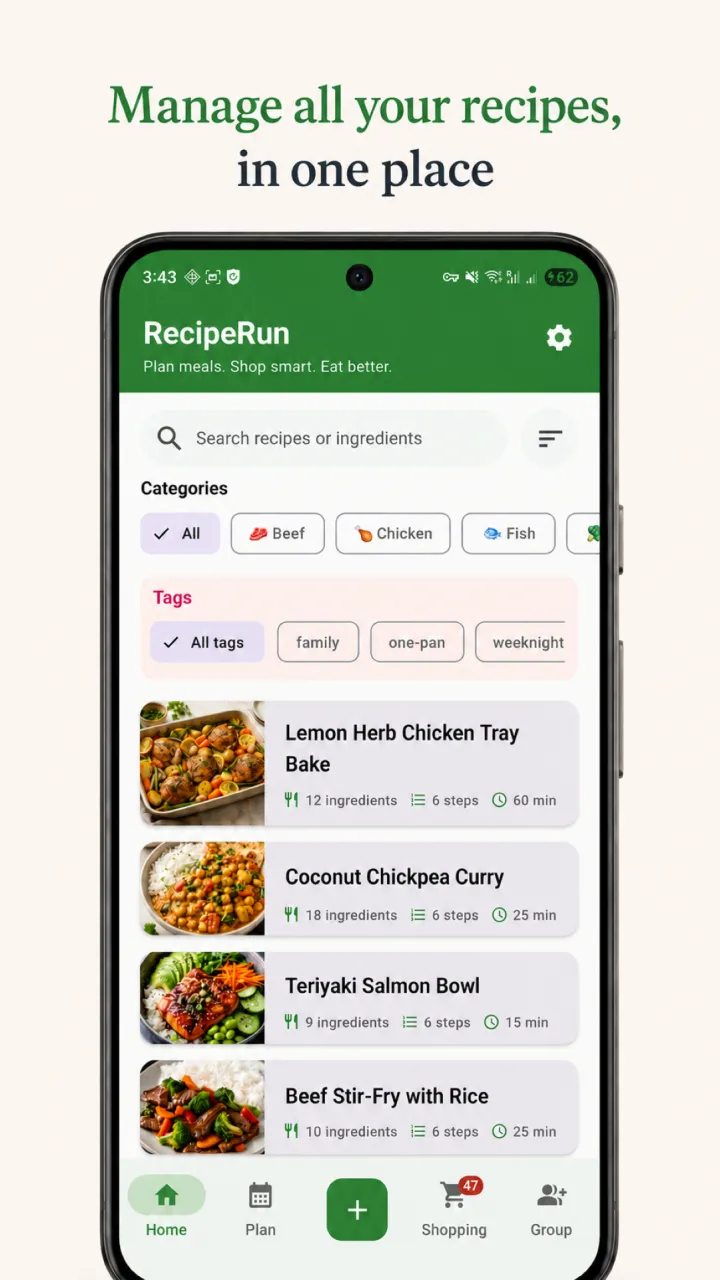
There is no universally best way to store recipes. Notes, spreadsheets and bookmarks are inexpensive, familiar and sometimes entirely sufficient. A dedicated recipe manager earns its place only when its structure and cooking features save more effort than they add.
This comparison uses practical household tasks rather than a feature-count score. It also explains where RecipeRun fits and where a simpler tool may be the more sensible choice.
The short comparison
Swipe horizontally to compare
| Need | Browser bookmarks | Notes app | Spreadsheet | Recipe manager |
|---|---|---|---|---|
| Save a website quickly | Excellent | Good with a pasted link | Manual | Good when URL import is supported |
| Store handwritten or printed recipes | Image files must be managed separately | Good for photos and short text | Awkward for images and long methods | Good when photo import is supported |
| Search consistently | Depends on page titles and browser folders | Good for text you entered | Good for structured columns | Good for structured recipe fields |
| Keep source context | Original page remains linked | Must be recorded | Must be recorded | Depends on the importer and app |
| Plan a week of meals | Manual | Manual checklist | Can be designed manually | Often built into the workflow |
| Build a grocery list | Copy ingredients manually | Copy ingredients manually | Formulas are possible but require setup | Often generated from planned recipes |
| Custom analysis | Limited | Limited | Excellent | Limited to the app’s design |
| Setup effort | Low | Low | Medium to high | Low to medium, plus migration and review |
| Main risk | Links can change or disappear | Inconsistent structure | Ongoing maintenance | App dependency and import errors |
The table describes typical strengths, not a promise about every product in each category. Individual browsers, notes apps, spreadsheets and recipe managers differ. If you decide an app is worth it, we compare seven recipe manager apps available in Australia, RecipeRun included.
Browser bookmarks: best for a small web-only collection
Bookmarks are the lowest-effort option when recipes already live on the web. The original page retains its photographs, author updates, comments and context, and you avoid making another copy to maintain.
Bookmarks work well when
- You use a small number of recipe websites.
- You are comfortable searching by page title or folder.
- You want to read the publisher’s current page each time.
- You do not need recipes to drive a meal plan or grocery list.
Their limits appear when
- A recipe disappears, moves or changes.
- Page titles do not match the name you remember.
- Recipes are mixed with hundreds of unrelated bookmarks.
- You also use cookbooks, screenshots and handwritten cards.
- You must copy ingredients manually every time you shop.
A bookmark is a pointer, not a self-contained recipe library. That is a strength when the source page is the product you want, and a weakness when you want a stable working version organised around your household.
Notes apps: best for quick, flexible capture
Notes are useful because they accept almost anything: a typed family recipe, pasted link, photograph, checklist or a change you made while cooking. Most people already understand the interface, and a short recipe does not need a complicated schema.
Notes work well when
- Most recipes are your own short text.
- You value free-form comments more than consistent fields.
- Device search reliably finds the terms you remember.
- You only plan or shop from a few recipes at a time.
Their limits appear when
- Titles, servings, ingredients and instructions follow no common pattern.
- A search for “chicken” returns shopping notes and conversations as well as recipes.
- Photographs contain text the notes search cannot reliably interpret.
- Ingredients still need to be copied into a separate grocery list.
- Several people create conflicting copies.
You can improve a notes-based system by using one title pattern and the same headings for ingredients and method. If that discipline solves the problem, a dedicated app may be unnecessary.
Spreadsheets: best for custom structure and analysis
Spreadsheets offer the most control. You can create columns for meal type, source, last cooked date or any other attribute, then sort and filter them. They are also portable and familiar in many households.
Spreadsheets work well when
- You enjoy designing and maintaining a system.
- Your recipes can be summarised in rows with links to full instructions.
- Custom sorting and analysis are the main goal.
- You need a catalogue more than a cooking view.
Their limits appear when
- Long ingredients and methods become difficult to read in cells.
- Images, source pages and structured text need to stay together.
- Grocery-list formulas must understand quantities, units and duplicate ingredients.
- The person who designed the sheet becomes its permanent administrator.
- Mobile editing at the bench or in the supermarket feels cumbersome.
A spreadsheet can be powerful, but capability is not the same as convenience. “It could calculate this” only helps if someone builds, tests and maintains the calculation.
Recipe managers: best for a connected cooking workflow
A recipe manager gives recipes a common structure and keeps them separate from general files and notes. Its main advantage is not merely storage; it can connect the saved recipe to what happens next.
A recipe manager is a strong fit when
- Recipes come from websites, photographs, paper and manual entry.
- You want to search one purpose-built library.
- You plan several meals before shopping.
- You want recipe ingredients brought into one grocery list.
- Household members need a shared plan or shopping list.
Its trade-offs include
- Imports can be incomplete and need review.
- Moving an existing collection takes time.
- Features and export options depend on the chosen app.
- Free and paid limits may affect a large collection.
- Storage, sync and privacy practices vary between apps and platforms.
- You become dependent on a particular interface and data model.
Before committing, import a small representative batch: one web recipe, one photograph, one family recipe and one complex ingredient list. Cook from them, generate a real shopping list and test the available backup or export process.
Compare systems by the whole weekly job
Storage is only the first step. A useful test follows a recipe through the week:
- Capture: How long does it take to save a web recipe or paper recipe accurately?
- Find: Can another household member locate it using the name they remember?
- Plan: Can you see what is being cooked and when?
- Shop: Can ingredients become one reviewed list without retyping?
- Cook: Is the recipe readable, complete and attributable at the bench?
- Correct: Can you fix an error without creating another conflicting copy?
- Protect: Can you back up or export the collection and retain important originals?
Score the steps you actually perform. A spreadsheet may win for catalogue analysis while a recipe manager wins for planning and shopping. If you never plan meals in advance, that recipe-manager advantage may have little value to you.
The hybrid approach is often sensible
Choosing a working system does not require forcing every source into it or deleting originals. A practical hybrid can use:
- A recipe manager for structured recipes you actively cook.
- Original website links for attribution and checking updates.
- High-quality image files for handwritten cards and family history.
- A spreadsheet for a specialised catalogue or project, if needed.
- Physical originals stored safely when they have personal value.
The important distinction is which version controls the day-to-day cooking workflow. Multiple reference copies are useful; multiple unlabelled master copies create confusion.
The guide How to Organise Recipes Digitally explains how to set up that working-copy and source-copy structure.
What RecipeRun does differently from a general tool
RecipeRun is built around a sequence: save a recipe, add it to the weekly meal plan, then generate its ingredients as part of the grocery list.
Its documented capabilities include:
- Importing recipes from cooking website links on the device.
- Extracting recipes from photos, screenshots and handwritten cards using AI.
- Keeping recipes in one searchable library.
- Planning breakfast, lunch and dinner across the week.
- Generating a grocery list while avoiding ingredient double-ups.
- Updating the list when the meal plan changes.
- Sharing recipes, meal plans and lists through Pro Family Groups.
- Comparing indicative selected-product prices at Woolworths, Coles and ALDI in Australia.
For Australian grocery comparisons, displayed prices can be cached, incomplete, unavailable or different at checkout. They are a planning aid rather than a guaranteed price. See the evidence-led Woolworths, Coles and ALDI comparison guide for a fair matching method.
Where RecipeRun may not fit
RecipeRun is not automatically better than a familiar notes file for every person. Consider another approach if:
- You only keep a handful of short personal recipes.
- You need a highly customised database or spreadsheet analysis.
- You require a desktop or web app rather than an Android or iOS app.
- You do not want AI processing for photo imports and do not want to enter those recipes manually.
- You require Australian supermarket price information to be exact, complete or guaranteed.
- The app’s backup, export, subscription or platform arrangements do not meet your requirements.
Recipe management, meal planning and grocery lists work worldwide. Supermarket price comparison is currently for Australian households. RecipeRun is free to download, with optional Pro features and limits described in the app.
Privacy, ownership and portability questions to ask
The tool category does not answer these questions by itself. A cloud notes service and a recipe app can have very different practices, while a local spreadsheet can still be lost if it is never backed up.
Before migrating a collection, ask:
- Where is ordinary recipe data stored?
- What is sent to a server when a URL or photo is imported?
- Is content used for AI training?
- Can the collection be exported in a usable form?
- What happens after uninstalling the app or ending a subscription?
- Can shared household members edit or delete content?
- Which backup or sync process applies to Android and iOS?
For RecipeRun, ordinary recipe data is stored locally unless a cloud-enabled feature is used. URL extraction runs on the device. Photo extraction sends the image securely for processing and may use third-party AI providers; RecipeRun states that uploaded content is not used to train AI models. Android offers optional backup to the user’s Google Drive, while iOS can use the user’s private iCloud database when sync is enabled. Read the current Privacy Policy and Terms for details and exceptions.
How to migrate without creating a mess
Whichever system you choose, begin with a reversible trial:
- Select ten recipes covering every source type you use.
- Keep the originals and current system unchanged during the trial.
- Import or enter each recipe and verify it against the source.
- Use the new system for one real week of finding, planning, shopping and cooking.
- Test backup or export before moving another batch.
- Write down one naming rule and one rule for retaining sources.
- Continue only if the trial removes meaningful work.
Do not measure success by the number of recipes migrated. Measure whether the household can find and use the right recipe with less retyping and uncertainty.
Try the recipe-manager workflow
If your main pain point is the gap between saved recipes and a grocery list, explore RecipeRun’s recipe manager features. The guide How to Turn Recipes Into One Grocery List Automatically shows the full planning workflow.
RecipeRun is free to download on Google Play and the App Store. Test it with a small representative batch before deciding where the rest of your collection should live.
Frequently asked questions
Is a recipe manager better than browser bookmarks?
It is better when you want a stable, structured library connected to planning and shopping. Bookmarks are simpler when you only need to revisit a small number of web recipes and prefer the publisher’s original page.
Should I store recipes in a spreadsheet?
A spreadsheet is useful for custom sorting and analysis, especially if each row links to a full recipe elsewhere. It is less natural for long cooking instructions, photographs and automatic grocery-list creation unless you build and maintain those workflows yourself.
Can a notes app organise recipes well?
Yes. A notes app can work well for a small collection if you use consistent titles and headings. It becomes harder to manage when recipes come from many sources or when ingredients must feed a weekly plan and shared grocery list.
What should I test before choosing a recipe app?
Test URL and photo import accuracy, search, meal planning, grocery-list output, editing, household sharing if needed, privacy settings, backup and export. Use recipes that represent the difficult parts of your real collection.
Can RecipeRun import TikTok, YouTube or video-file recipes?
Yes. RecipeRun can import recipes from TikTok and YouTube links or uploaded video files. It can also import from cooking websites and extract recipes from photographs, screenshots or handwritten cards, subject to review and feature limits.
Sources and disclosure
- RecipeRun product behaviour documented on the recipe manager page, Privacy Policy and Terms of Service, accessed 13 July 2026.
- National Archives of Australia guidance on preserving paper files, used for the distinction between working recipe entries and preservation copies.
- IP Australia overview of copyright.
This comparison is published by the team that makes RecipeRun. It does not rank RecipeRun against named competing apps, and it deliberately identifies cases where bookmarks, notes or spreadsheets may be the better choice.